Masterworks from the Art Institute of Chicago
Chicago, Illinois • Impressionism, Neo-Impressionism & American Regionalism
Founded in 1879 and guarded by its pair of bronze lions on Michigan Avenue, the Art Institute of Chicago holds one of the greatest collections of Impressionist and Post-Impressionist painting outside Paris. Much of that strength comes from early Chicago collectors like Bertha Honoré Palmer and Martin A. Ryerson, who bought daring French canvases long before conservative museums on the East Coast were willing to hang them.
Here you will find five of the museum’s best-loved works: Georges Seurat’s wall-sized A Sunday on La Grande Jatte, Gustave Caillebotte’s Paris Street; Rainy Day, Pierre-Auguste Renoir’s radiant Two Sisters (On the Terrace), Claude Monet’s 1906 Water Lilies, and Grant Wood’s 1930 prize-winning American Gothic.
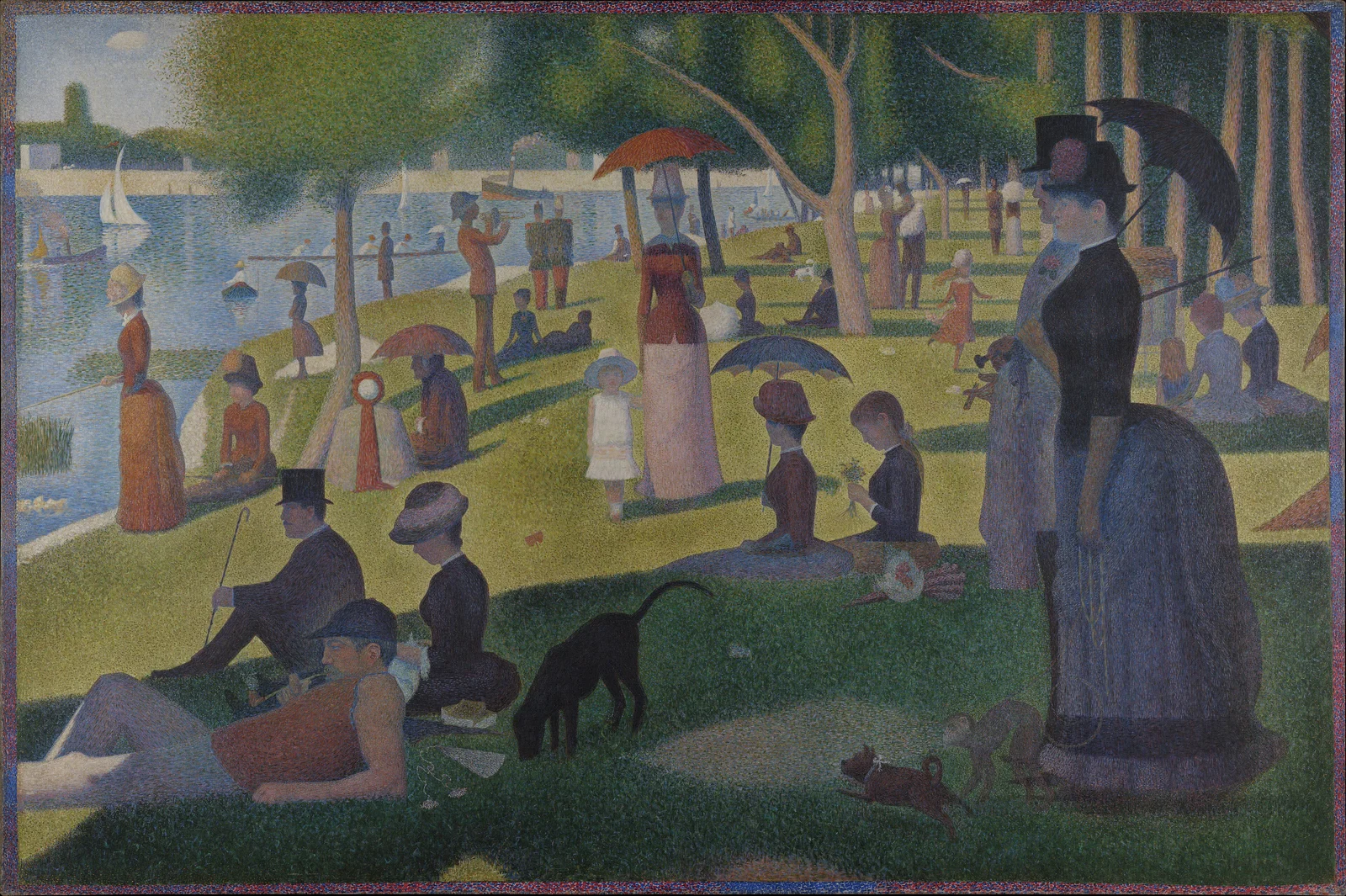
A Sunday on La Grande Jatte
Georges Seurat (1884–1886)
This revolutionary monument of Neo-Impressionism forever changed modern art by fusing classical frieze-like grandeur with nineteenth-century scientific color theory. Rejecting traditional palette mixing, the entire canvas is constructed from thousands of precision pointillist dots of pure, unblended pigment. Viewed from a distance, the human retina performs optical mixing, causing complementary hues to vibrate with a luminosity no brush-mixed paint could achieve, right out to the hand-painted pointillist border framing the scene.
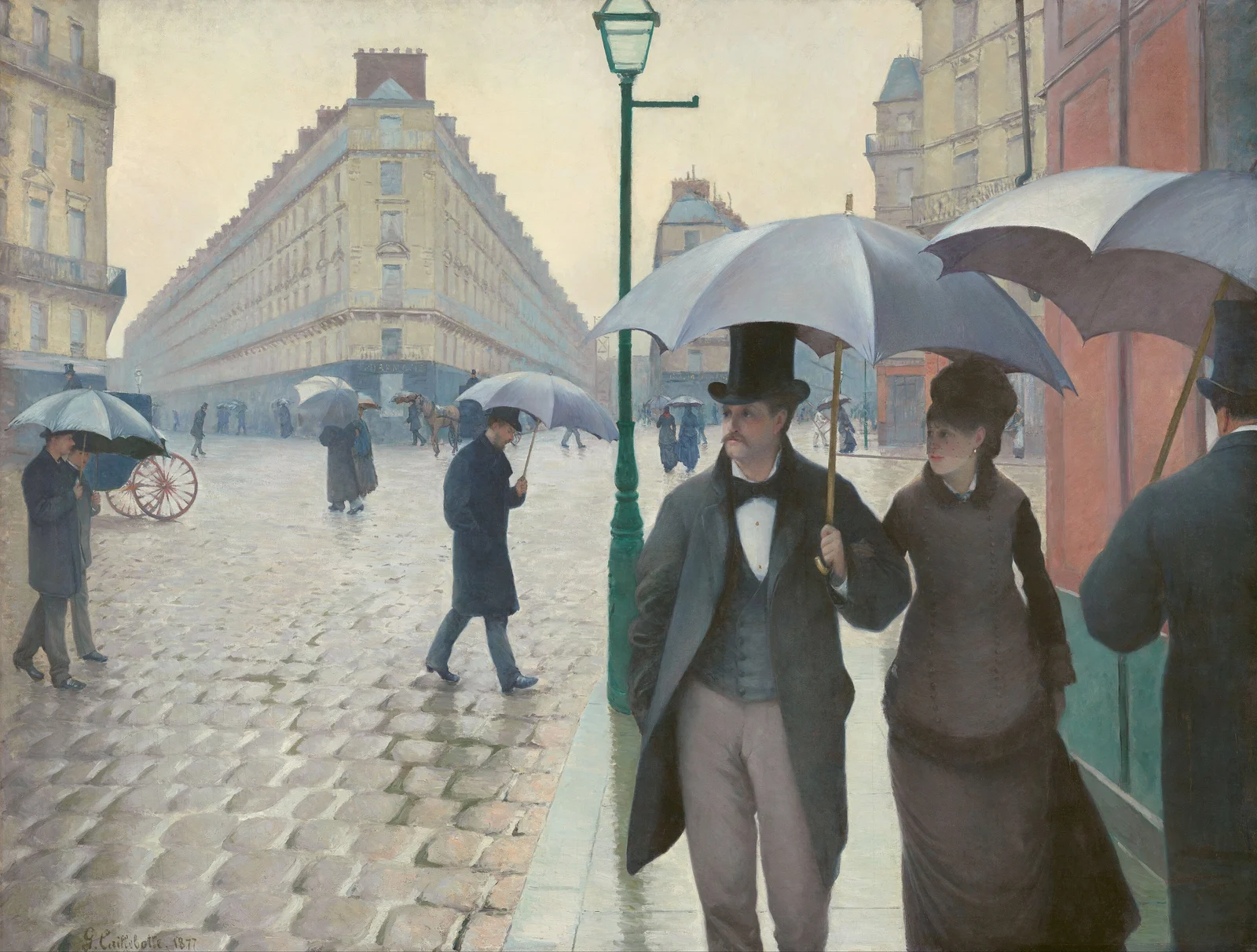
Paris Street; Rainy Day
Gustave Caillebotte (1877)
Standing at the crossroads of French Impressionism and modernist realism, this monumental work chronicles the psychological experience of the newly redesigned nineteenth-century metropolis. Engineered with rigorous two-point perspective and bold photographic cropping, the composition bisects the canvas vertically to create cinematic tension between urban proximity and modern anonymity. Across the foreground, subtle tonal gradations of pearl-gray, ochre, and slate capture the exact optical diffusion of overcast light reflecting off rain-slicked stone.
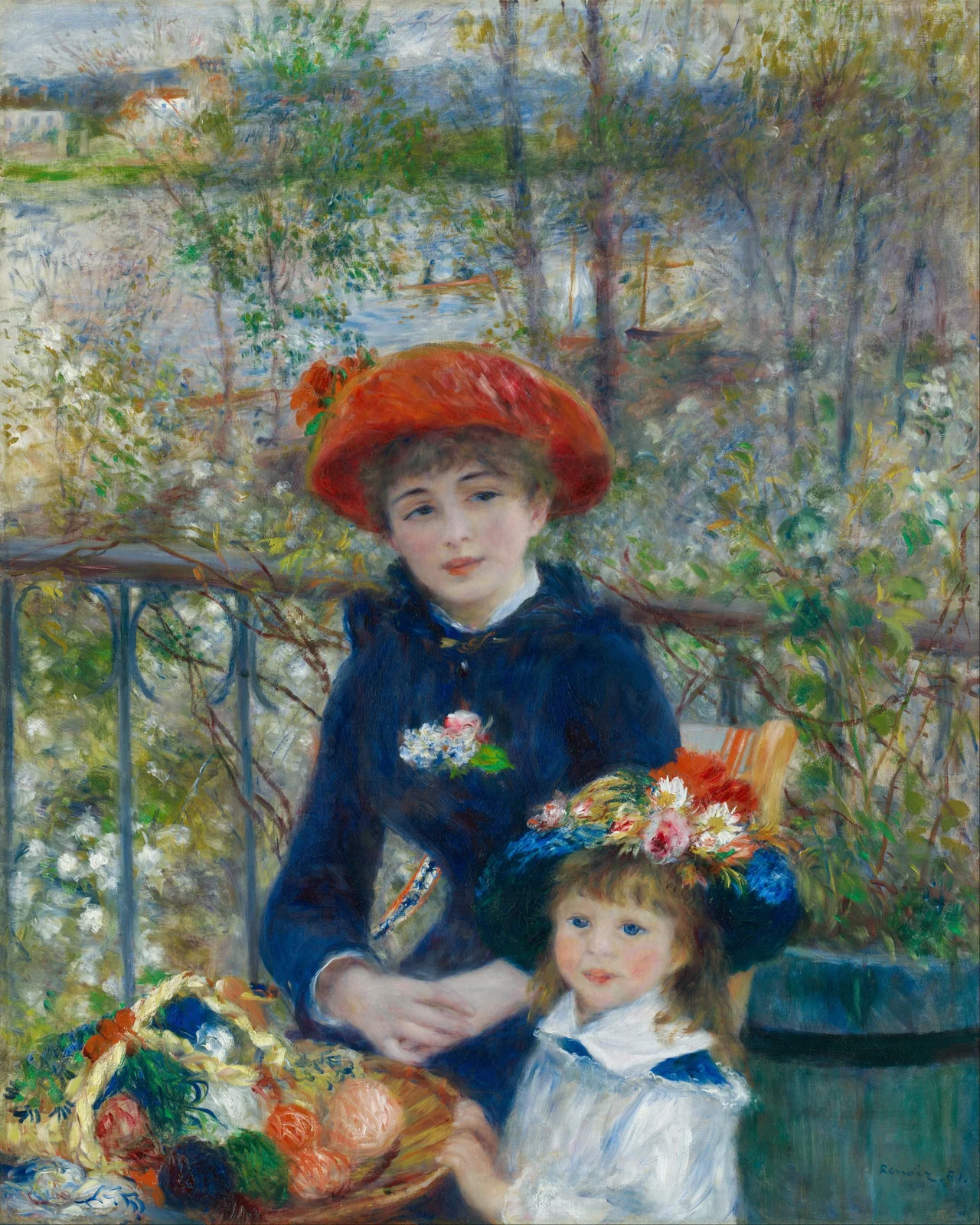
Two Sisters (On the Terrace)
Pierre-Auguste Renoir (1881)
Celebrated as a tour de force of French Impressionism, this radiant canvas is a masterclass in the orchestration of color, texture, and outdoor light. Rather than relying on dark shadows to model depth, the composition builds volume through vibrant chromatic contrast and atmospheric perspective. A striking duality of brushwork defines the surface, pairing porcelain-smooth academic precision on the figures’ faces with feathery, unblended strokes in the river foliage that blend optically in the viewer’s eye.
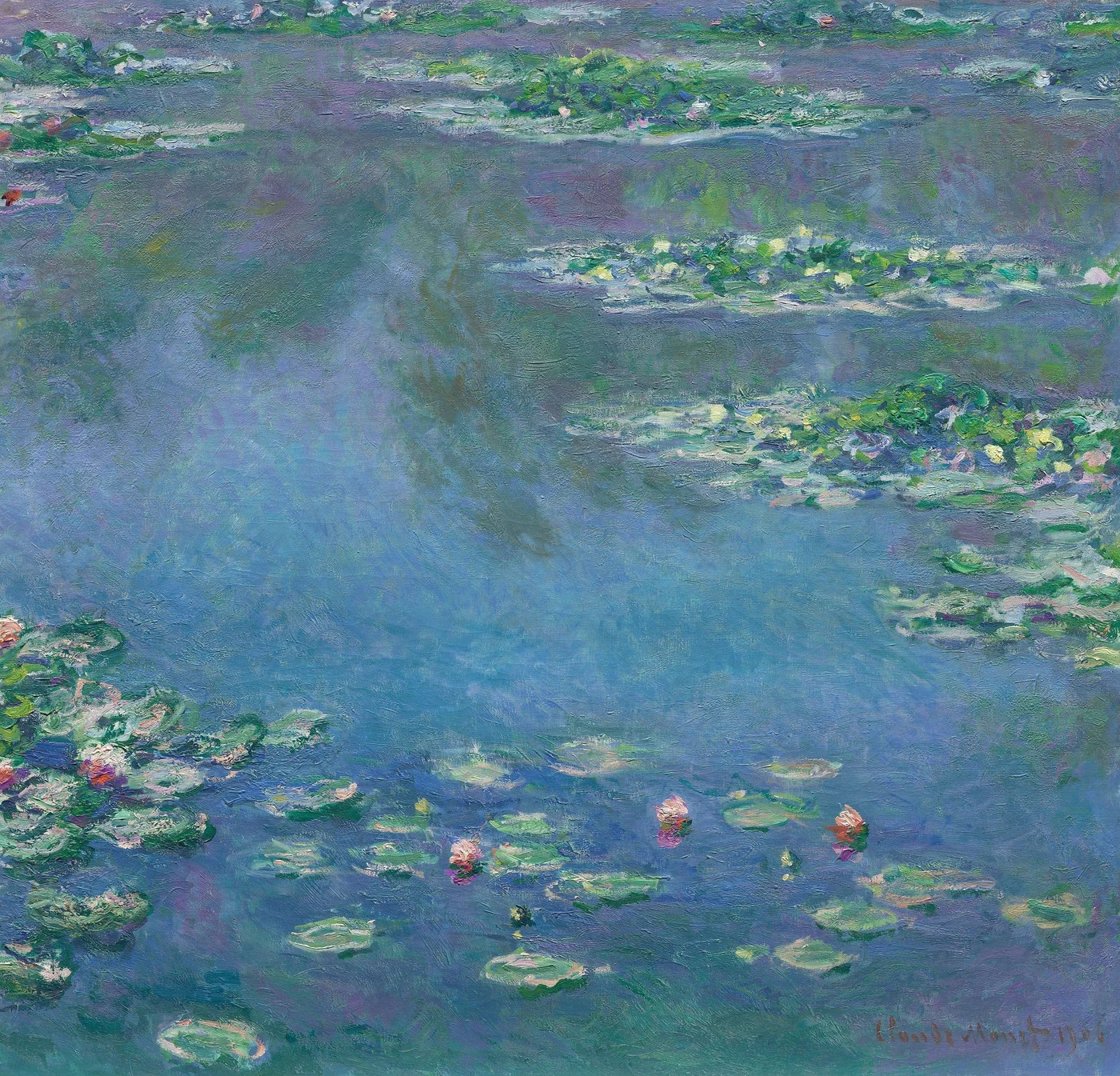
Water Lilies
Claude Monet (1906)
A radical milestone of late French Impressionism, this immersive canvas abandons traditional landscape conventions to explore pure reflection, color, and optical sensation. By eliminating both the rocky shoreline and the overhead sky, the composition transforms the surface of the pond into an all-over field of floating blossoms that directly anticipated twentieth-century Abstract Expressionism. Built from layered, scumbled brushwork of cobalt, violet, and viridian, the water simultaneously reflects the unseen clouds above while anchoring the eye in tranquil depth.
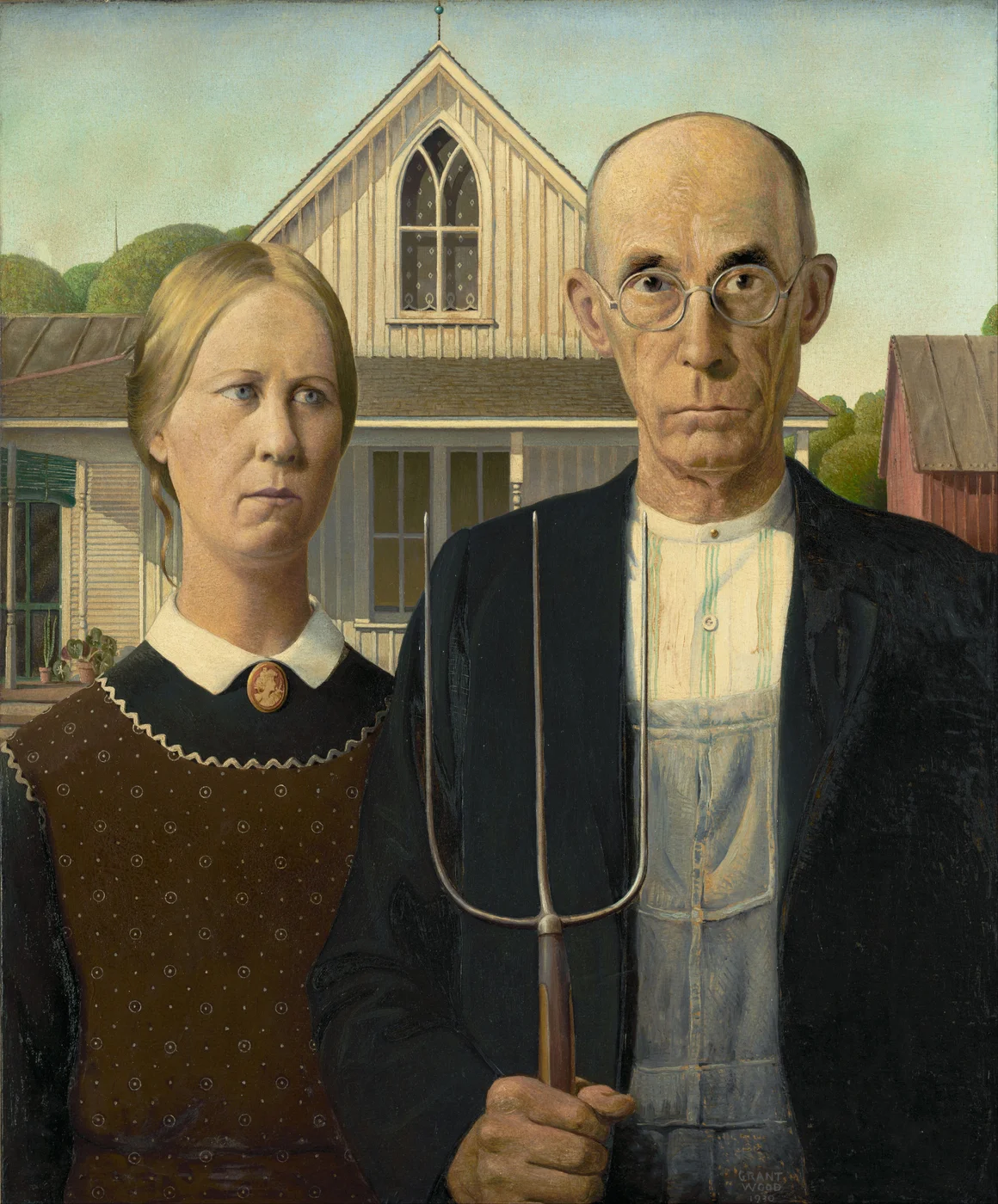
American Gothic
Grant Wood (1930)
An unmistakable touchstone of twentieth-century American Regionalism, this iconic double portrait distills heartland resilience with quiet dignity, dry wit, and architectural rigor. Inspired by a Carpenter Gothic cottage and the crisp realism of Northern Renaissance portraiture, the composition locks the figures inside a tight pyramidal frame echoed by the pointed upper window arch. Every detail reinforces this strict vertical geometry, from the three-tined pitchfork mirrored in the stitched overalls to the frontier heirloom cameo pinned at the collar.
Have another favorite painting in mind?
We can turn any archival artwork into a double-sided canvas tote bag, ceramic mug, throw pillow, hardcover journal, or ornament, complete with a custom-researched wall plaque on the back.