American Gothic: An Architectural Sketch That Became a National Inkblot
How Grant Wood’s glance at an Iowa crossroads cottage led him to cast his sister and Cedar Rapids dentist inside a Northern Renaissance panel structure.
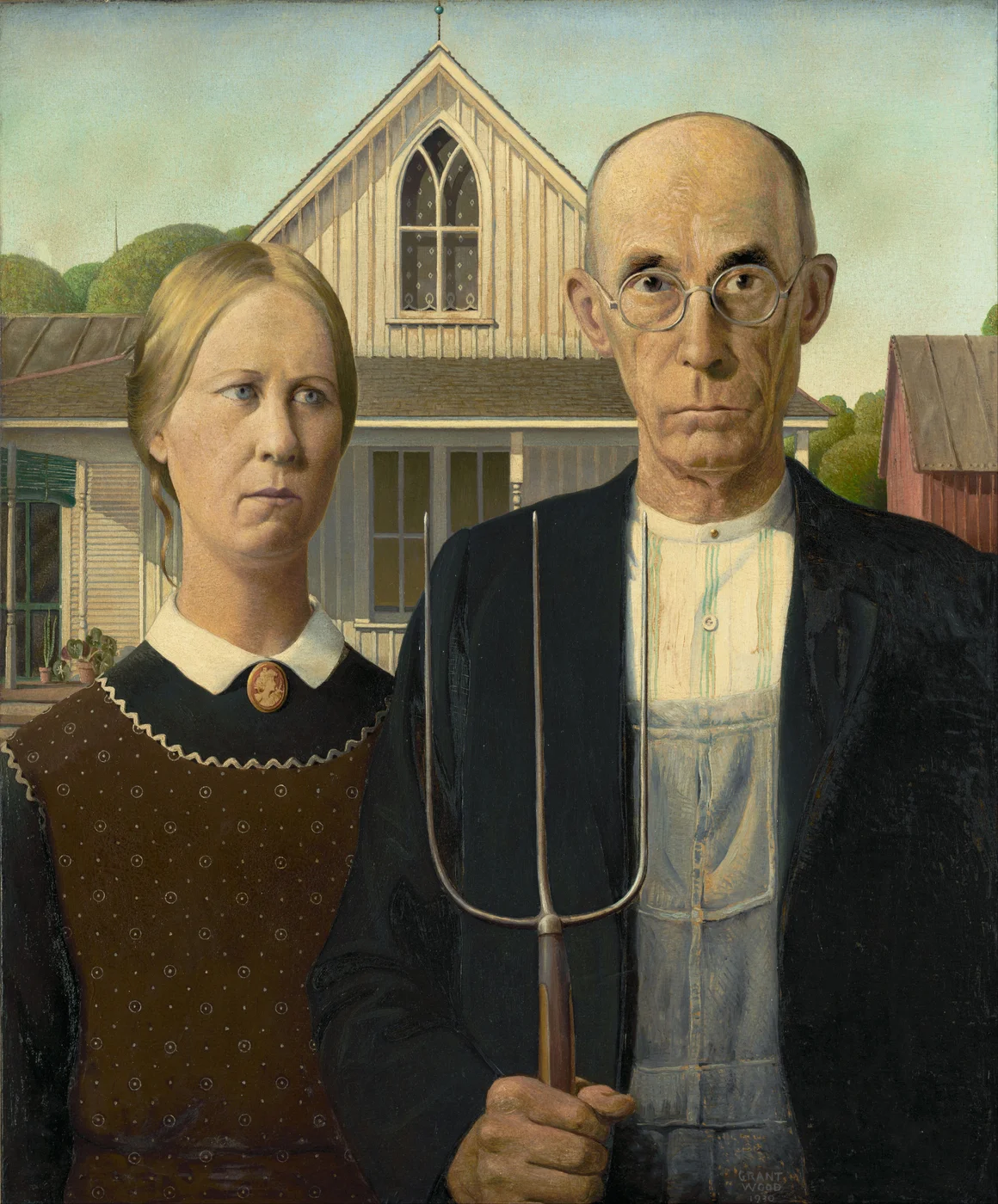
- Original Title
- American Gothic
- Artist
- Grant Wood (1891–1942)
- Date
- 1930
- Medium & Support
- Oil on Beaver Board (compressed wood-pulp composition fiberboard)
- Dimensions
- 78 × 65.3 cm (30 3/4 × 25 3/4 in)
- Repository
- Art Institute of Chicago (Gallery 263, Friends of American Art Collection, Inv. 1930.934)
- Provenance
- Awarded the Norman Wait Harris Bronze Medal and $300 purchase prize at the Art Institute of Chicago Forty-Third Annual Exhibition of American Paintings and Sculpture (1930); acquired directly by the museum through the Friends of American Art
- Diagnostic Conservation
- Technical examination by Inge Fiedler (1995) documented thin oil glazes over an opaque ground on Beaver Board with negligible modern overpaint
An unmistakable touchstone of twentieth-century American Regionalism, this iconic double portrait distills heartland resilience with quiet dignity, dry wit, and architectural rigor. Inspired by a Carpenter Gothic cottage and the crisp realism of Northern Renaissance portraiture, the composition locks the figures inside a tight pyramidal frame echoed by the pointed upper window arch. Every detail reinforces this strict vertical geometry, from the three-tined pitchfork mirrored in the stitched overalls to the frontier heirloom cameo pinned at the collar.
Material & Compositional Details
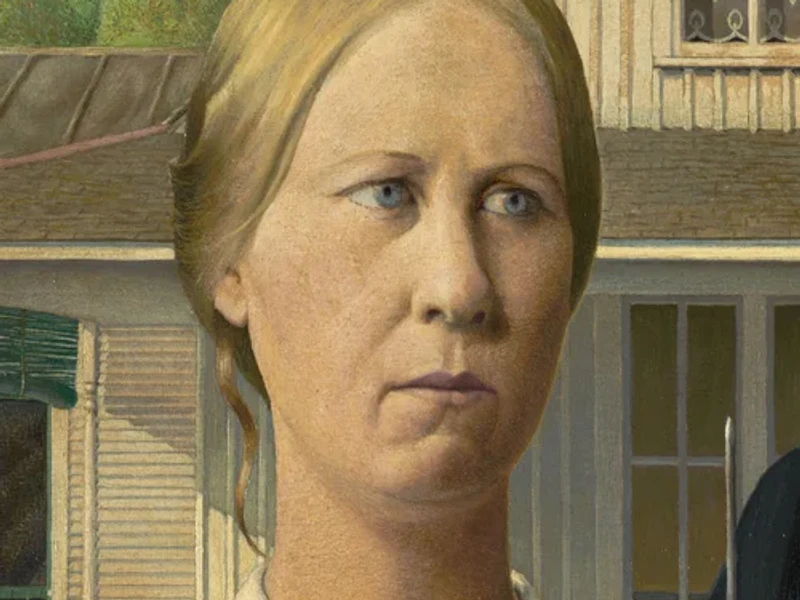
Enlarged regions from the Art Institute of Chicago photograph highlighting Grant Wood’s Carpenter Gothic geometry, heirloom props, and Beaver Board glaze brushwork.
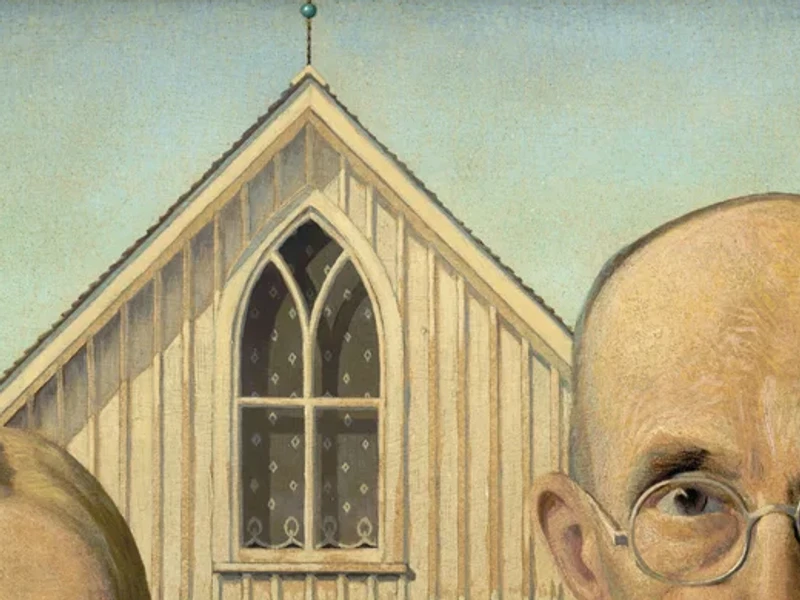
The Carpenter Gothic Window
Derived from the 1881–1882 Dibble House in Eldon, Iowa, the three-lobed lancet window and vertical board-and-batten siding establish a strict symmetry behind both figures.
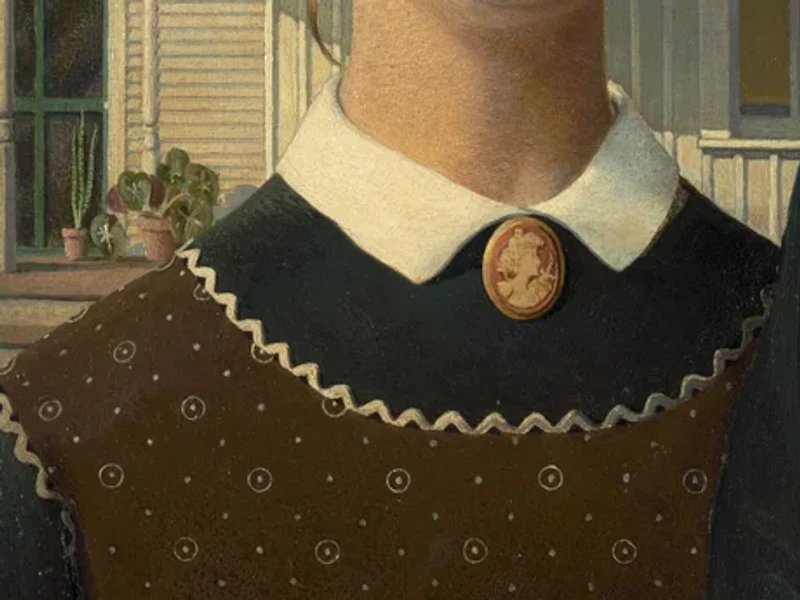
Persephone Cameo & Rickrack Trim
Unable to buy period calico ugly enough to look authentic, Wood had his sister Nan trim a colonial apron with cotton rickrack and wear their mother’s carved shell Persephone cameo.
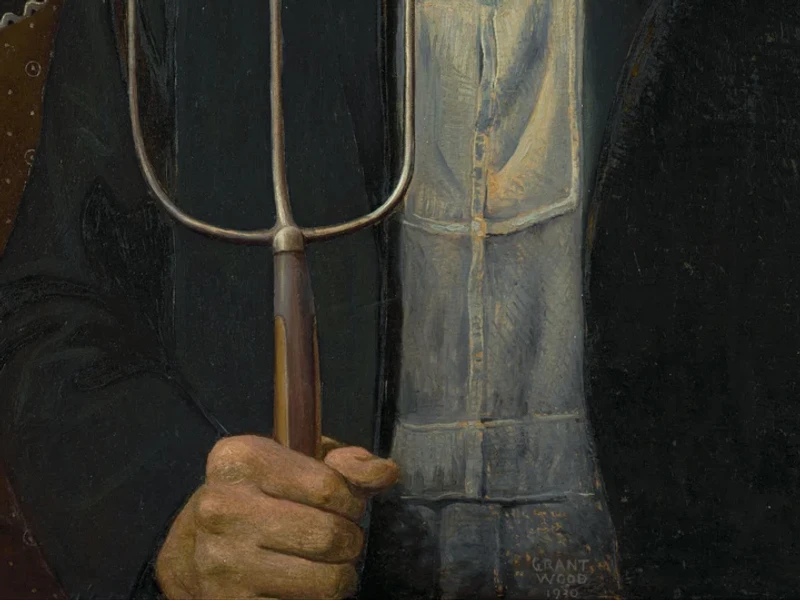
Clenched Grip & Painted Signature
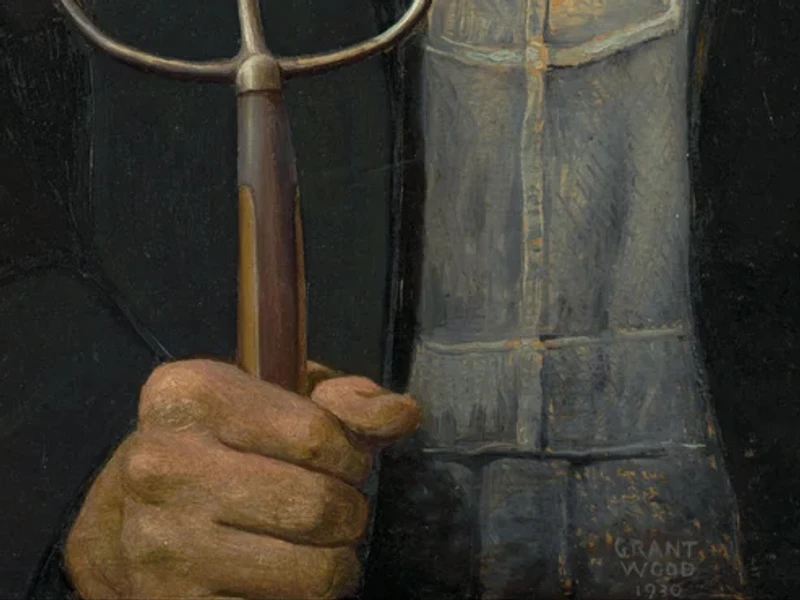
Held dead upright like a medieval emblem rather than an active farm tool, the three-tined fork steers the eye down into the denim seams and Wood’s crisp block signature.
In late summer 1930, Grant Wood caught sight of a tiny timber house in Eldon, Iowa, sporting a pointed second-story lancet window far too theatrical for a modest three-room cottage. Rather than treating the incongruity as a joke, Wood spent the next several months building an exacting panel painting in his Cedar Rapids studio that wedded small-town carpentry to fifteenth-century Flemish glaze technique.
From an Eldon Crossroads Cottage to Chicago’s Forty-Third Annual
Traveling through southern Iowa in August 1930 for an exhibition in Eldon, Grant Wood stopped short before a small white timber dwelling erected between 1881 and 1882 by Catherine B. and Charles A. Dibble on Lot 14 of the Jaques Addition. What amused and captivated Wood was a borrowed cathedral motif stitched onto prairie lumber: a tall, pointed Gothic arch window squeezed right beneath the steep peak of a modest carpenter-built frame cottage. In nineteenth-century America, pattern books circulated by landscape theorist Andrew Jackson Downing and architect Alexander Jackson Davis popularized such Carpenter Gothic flourishes for country cottages and rural towns alike, and seeing that architectural ambition intact in Wapello County sparked the entire painting.
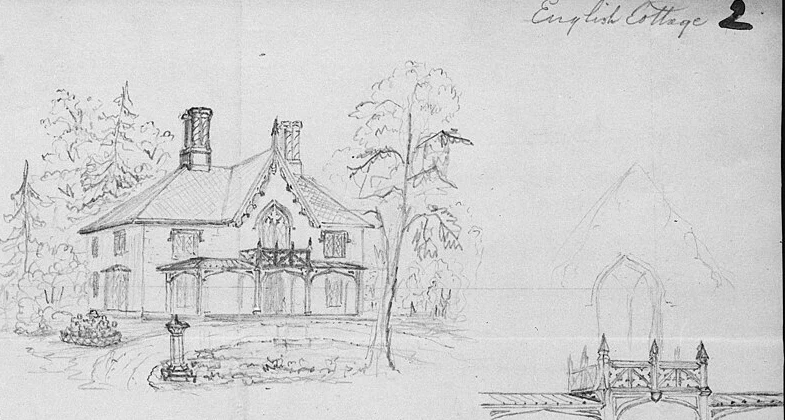
Crucially, Wood never posed the real Eldon homeowners on their front steps. Back in his Cedar Rapids studio, he sketched the cottage on envelope paper and an oil study board, then drafted two people closest to home to inhabit it: his younger sister Nan Wood Graham (1899–1990) and Cedar Rapids dentist Dr. Byron McKeeby (1867–1950). The pair posed separately, never standing shoulder to shoulder in front of the house, and McKeeby only agreed after Wood promised to obscure his recognizable features enough to avoid teasing from patients. Yet when the Art Institute of Chicago hung the finished panel in October 1930 and awarded it the Norman Wait Harris Bronze Medal alongside a $300 purchase prize, newspaper syndicate wire photos launched an instant public uproar: outraged Iowans saw slick-city ridicule, New York critics hailed a piercing national archetype, and Nan spent decades insisting they portrayed a pious small-town farmer and his unmarried daughter rather than an aging married couple.
Beaver Board, Translucent Glazes, and Grant Wood’s Rejection of Impressionism
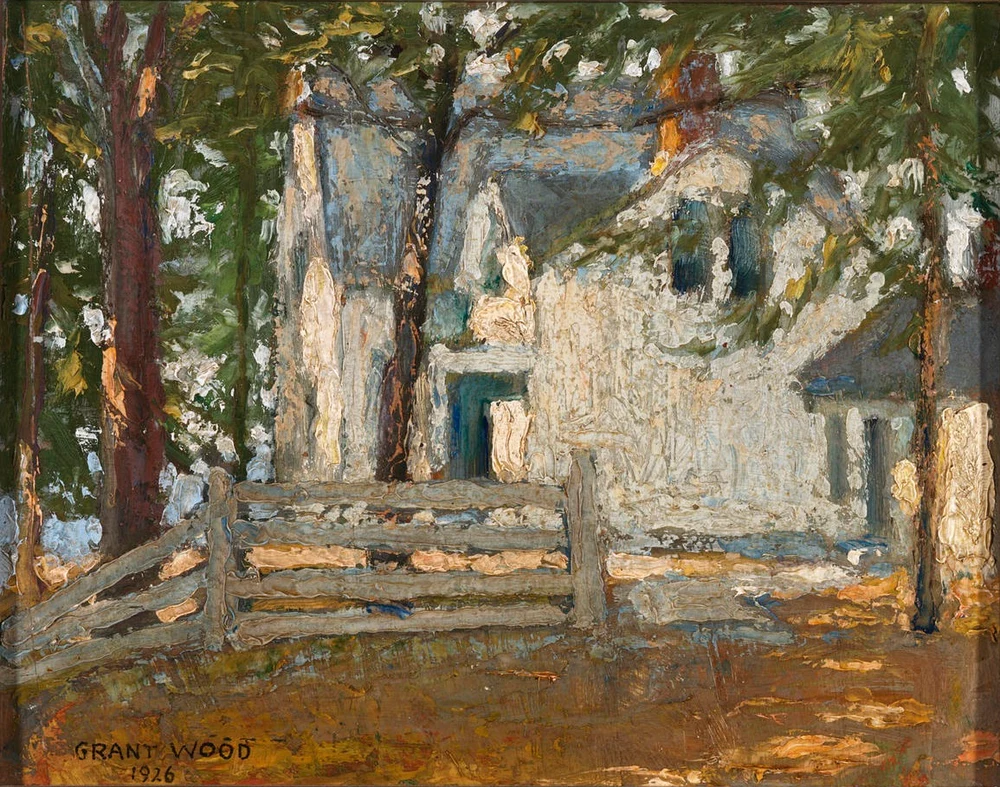
Only four years before completing American Gothic, Grant Wood was still painting sunny, heavily troweled Impressionist landscapes on his European trips to France and Italy, building up choppy crusts of oil paint like Grandma Wood’s House (1926). Everything pivoted in autumn 1928, when a civic commission for the Cedar Rapids Veterans Memorial Building’s stained-glass window sent Wood to Munich to supervise its fabrication at the Emil Frei studio. Standing daily in Bavarian galleries before fifteenth- and sixteenth-century Northern European panels, Wood concluded that French Impressionist brushwork looked imported and thin against the crisp, clear-eyed realism of Flemish and German Old Masters.
Back in Iowa, Wood swapped textured linen canvas for hardware-store Beaver Board: rigid, compressed wood-pulp wallboard whose flat industrial grain let thin pigments lie as tight and luminous as porcelain enamel. In her 1995 technical study ("A Study of the Materials Used in Grant Wood’s American Gothic"), Art Institute of Chicago conservation scientist Inge Fiedler examined microscopic paint cross-sections and X-radiographs of the panel, confirming how methodically Wood built his illusion. Over an opaque pale ground priming the Beaver Board, Wood laid fine, translucent oil glazes with small sable brushes, stippling warmth onto weathered knuckles and cheekbones while keeping the underlying wood-pulp panel nearly free of heavy modern overpaint. Because compressed fiberboard expands and contracts dramatically with ambient humidity, the Art Institute tracks gallery climate tightly to prevent planar warping or hairline tension along the rigid board.
Strict Geometry: From the Lancet Arch to Three Steel Tines
Part of American Gothic’s uncanny staying power lies in its concealed abstract scaffolding. Wood anchored the entire 78-by-65.3-centimeter panel on repeating three-part verticals and pointed triangles so that figures and carpentry fuse into a single frontal emblem. Above, the house gable forms an inverted V crowned by a wrought finial; directly below, Dr. McKeeby’s hayfork thrusts upward like an earthly reflection of the cathedral window, its central steel prong repeating cleanly into the vertical pinstripe button placket of his collarless work shirt and the crisp center seam of his denim overalls.
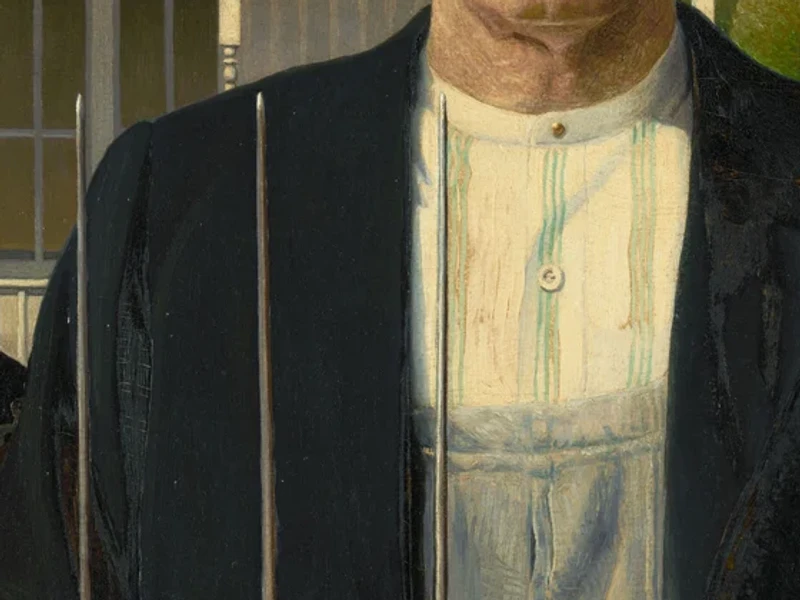
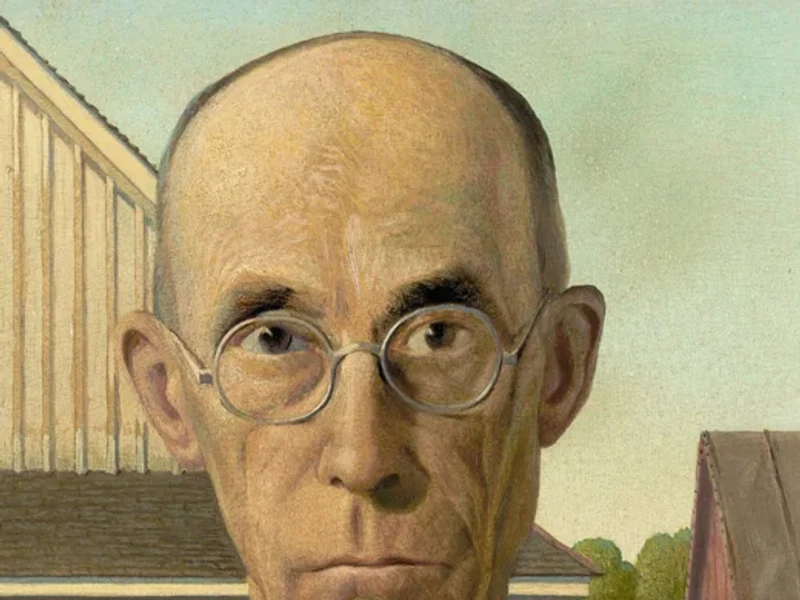
Nothing in either figure breaks that architectural discipline. McKeeby confronts the viewer head-on behind perfectly circular wire spectacles, his bald crown echoed by the curved wooden arches behind him and flanked on the far right by a steep red barn roof. Nan stands half a pace farther back, angling slightly left while her cool blue eyes glance off-frame toward her companion, her face narrowed slightly by Wood beyond her natural proportions so her oval head rhymes with the Gothic arch overhead. Behind her right ear, a single rebellious curl drops past the wooden shutters, the solitary soft curve against two rows of unforgiving straight boards.
Heirloom Props: How Woman with Plants Reappeared Inside Eldon
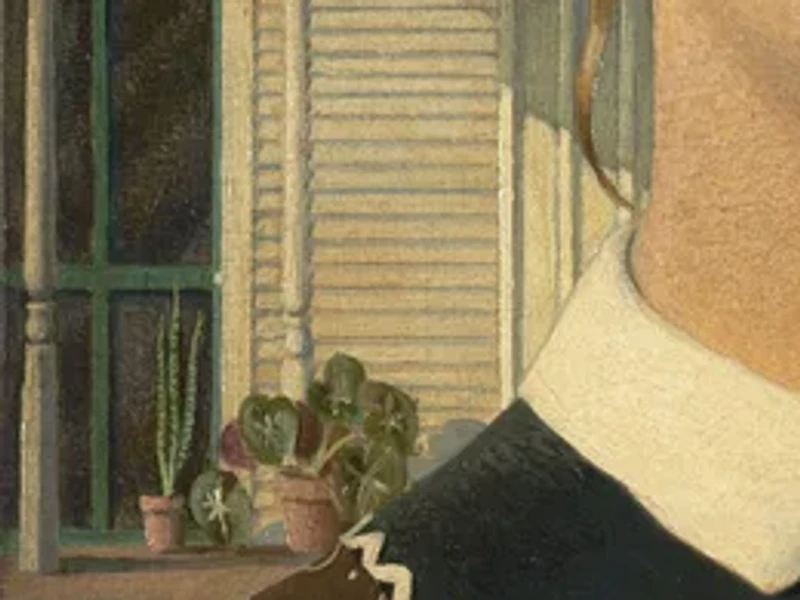
Every textile and houseplant in American Gothic carries private family history disguised as generic prairie austerity. Searching Cedar Rapids department stores in 1930, Wood complained that ready-made prints looked far too stylish for the turn-of-the-century severity he envisioned. In response, Nan stitched antique cotton rickrack braid onto a brown dot-patterned colonial apron over a plain black jacket, and Wood borrowed an heirloom carved shell cameo brooch depicting the Greek goddess Persephone that belonged to their late mother, Hattie Weaver Wood.
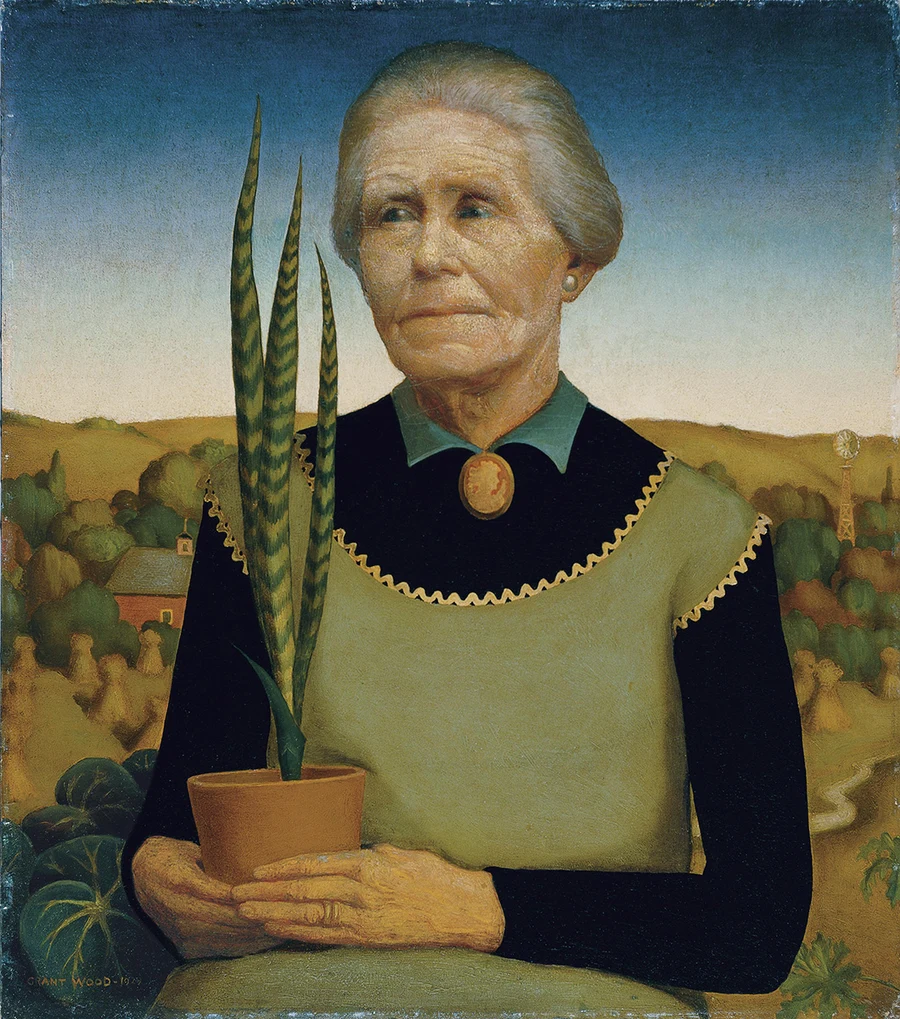
Comparing American Gothic alongside Woman with Plants, painted just one year earlier in 1929 as a tender tribute to his mother, reveals a deliberate artistic relay. Not only did Hattie Weaver Wood wear the exact same Persephone cameo brooch at her throat and the same scalloped white rickrack apron trim across her chest, she cradled a terracotta-potted snake plant (Sansevieria, long nicknamed mother-in-law’s tongue) while spotted leaves of a beefsteak begonia peaked at lower left. When Wood moved to Eldon’s white clapboard porch in 1930, he tucked those identical two family potted plants quietly behind his sister’s shoulder on the porch edge, preserving his mother’s quiet domestic steadiness inside a painting the public mistook for satire.
Precedents & Influences Behind the Painting
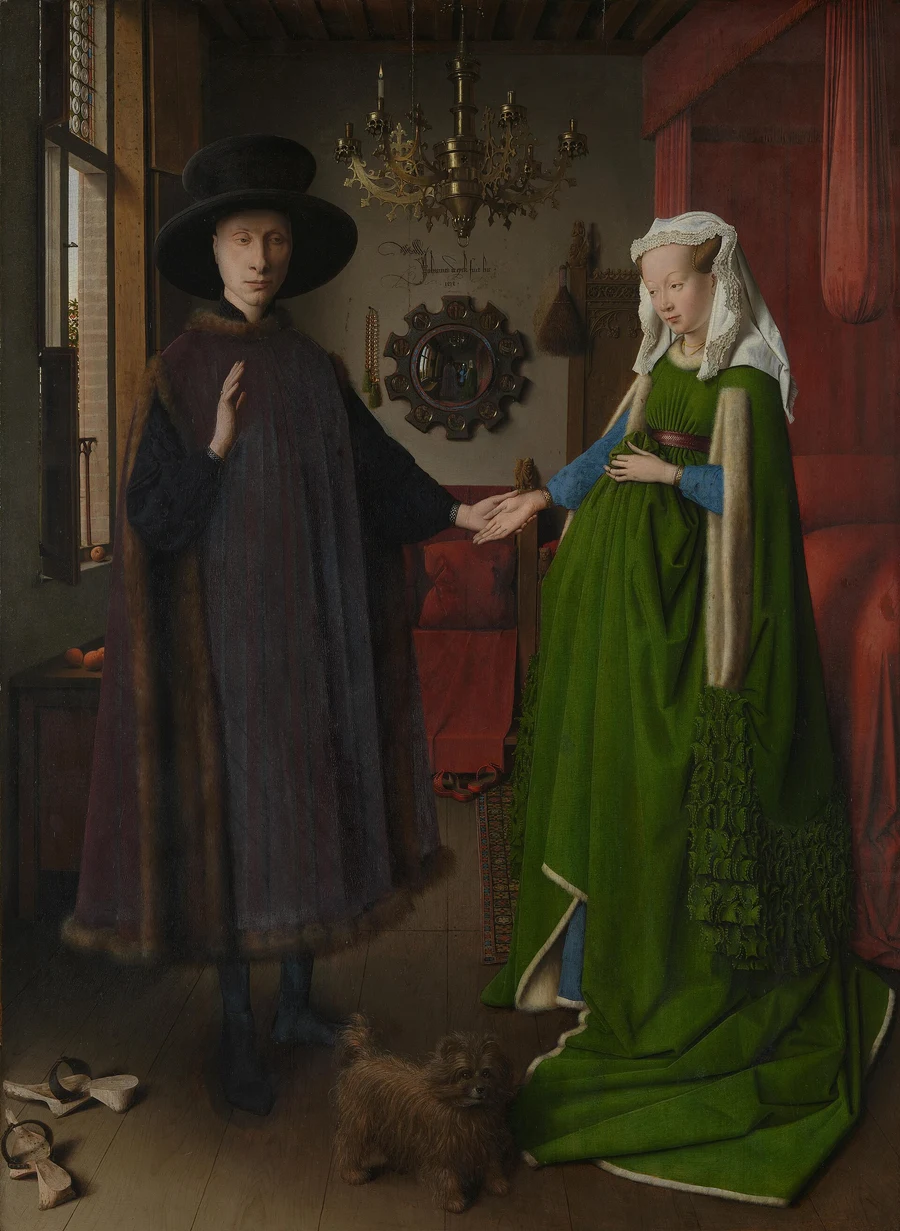
Before his 1928 Munich sojourn, Wood viewed European modernism as the standard for progressive art; afterward, he realized that fifteenth-century Northern Renaissance oil masters offered an architecture built specifically for unvarnished northern light and ordinary faces. Painters such as Jan van Eyck, Hans Memling, and later Hans Holbein built devotional diptychs and merchant double portraits on tight wood panels where every fur hair, leaded window pane, and linen hem carries equal democratic weight. Standing in 1928 before early Netherlandish panels like Jan van Eyck’s Arnolfini Portrait (1434) gave Wood permission to render Iowa wool, denim, wire eyeglasses, and weatherboard paint with sacred concentration.
Just as vital were nineteenth-century photography and early American regional illustration. Wood possessed stacks of Midwestern family tintypes and daguerreotypes whose stiff, long-exposure solemnity stemmed from sitters holding still rather than feeling grim. By blending photographic frontal frankness with Northern Renaissance layered glazes, Wood achieved a hybrid idiom that broke cleanly from French atmospheric impressionism (even as Chicago collectors already prized French modernists such as A Sunday on La Grande Jatte (1884–1886) in the museum galleries next door). Every tight strand of Nan’s hair and stiff fold of cloth turns prairie modesty into civic monumentality.
Onward Influence
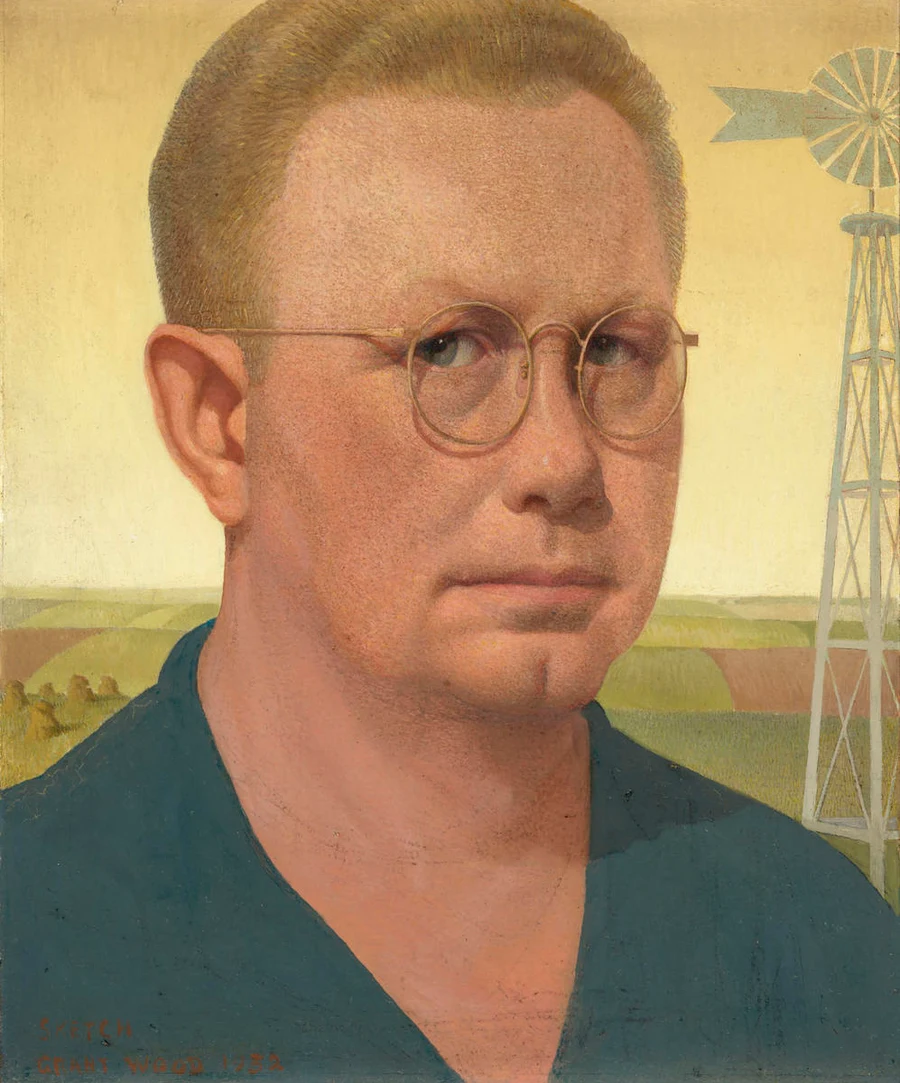
Within two years of its Chicago debut, American Gothic vaulted Wood to national prominence as a leading voice of American Regionalism alongside Thomas Hart Benton and John Steuart Curry. When Wood sat down to paint his own Self-Portrait in 1932, he applied the exact same crisp glaze modeling and wire-rimmed visual grammar against geometric green Iowa hillsides and a lone steel windmill, turning rural midwestern labor into an unmistakably modern subject at the height of the Great Depression. Inside Chicago itself, the work quickly grew into an enduring gallery pillar beside landmarks like Georges Seurat’s A Sunday on La Grande Jatte and Gustave Caillebotte’s geometric Paris Street; Rainy Day.
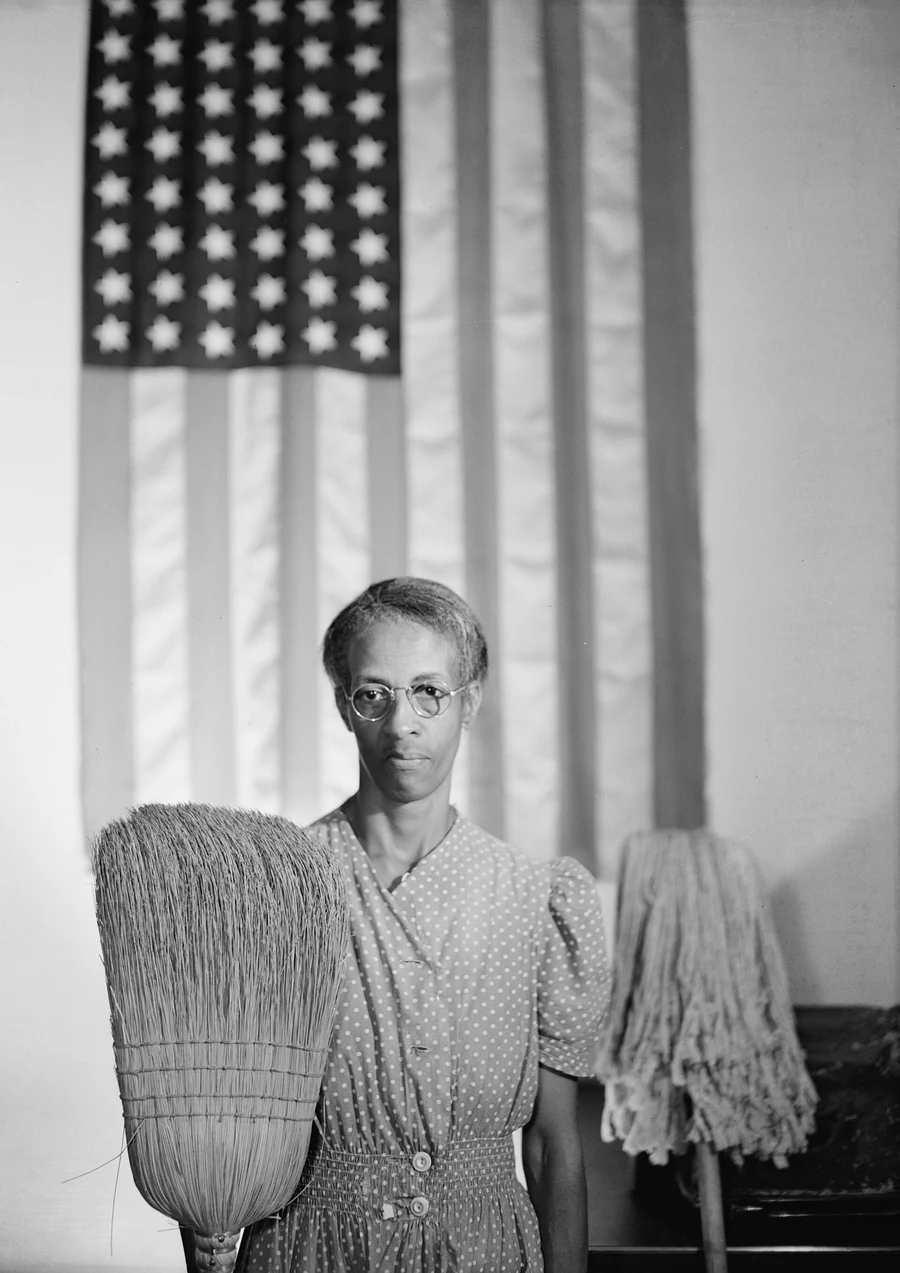
Because Wood’s silhouette was immediately legible at newspaper resolution, few twentieth-century paintings entered popular visual vocabulary so fast or sustained such pointed reinvention. The watershed transformation arrived in August 1942, just six months after Wood’s death, when twenty-nine-year-old Farm Security Administration photographer Gordon Parks posed Ella Watson, a Black government charwoman cleaning offices in Washington, D.C., clutching a broom in her right hand and a mop behind her left shoulder in front of a hanging American flag. Titled American Gothic, Parks’s stark silver gelatin confrontation transformed Wood’s Midwestern emblem of fortitude into an unforgettable indictment of wartime segregation, opening a decades-long lineage of documentary photography, Pop parody, and political revision that continues whenever critics ask what American face belongs in the frame.
Carry the Painting & Its Curated Description
Every keepsake below features Grant Wood’s American Gothic on the front and its curated description on the reverse, with free US shipping.
 $35
Canvas Tote Bag
15" × 16" Natural Canvas
 $22
Ceramic Mug
11oz White Glazed Ceramic
 $38
Throw Pillow
16" × 16" Woven Canvas w/ Insert
 $28
Hardcover Journal
5.75" × 8" Ruled Pages (150pp)
 $18
Ceramic Ornament
3" Round Porcelain w/ Gold Cord
Frequently Asked Questions About American Gothic
Who are the two models in Grant Wood’s American Gothic, and are they husband and wife?
Grant Wood painted his younger sister Nan Wood Graham (1899–1990) alongside his Cedar Rapids dentist Dr. Byron McKeeby (1867–1950), posing each one individually in his studio rather than beside the Eldon cottage. Wood and his sister always explained the pair as a pious small-town farmer and his dutiful unmarried daughter, though viewers still frequently mistake them for a stern husband and wife.
Does the American Gothic house really exist in Iowa?
Yes. Known historically as the Dibble House, the white clapboard cottage still stands in Eldon, Iowa, where it was erected in 1881–1882 on Lot 14 of the Jaques Addition. Listed on the National Register of Historic Places in 1974 (NRHP 74002291), it now anchors the American Gothic House Center.
Why did Grant Wood paint American Gothic on Beaver Board instead of stretched canvas?
Following his 1928 Munich trip studying Flemish and German panel painting, Wood abandoned textured French Impressionist brushwork. Commercial Beaver Board (dense compressed wood-pulp wallboard) gave him a smooth, rigid plane suited to hard contours and thin oil glazes without the weave texture of woven canvas.
What did Gordon Parks photograph in his 1942 response titled American Gothic?
Working for the Farm Security Administration in August 1942, Gordon Parks photographed Ella Watson, a Black government charwoman in Washington, D.C., standing rigidly with a broom and mop before the stars and stripes. Retaining Wood’s unblinking symmetry and vertical tool motif, Parks turned a familiar national icon into a direct social critique of segregation.