Girl with a Pearl Earring: Two Brushstrokes of Lead White and a Vanished Green Curtain
How Johannes Vermeer used crushed Afghan lapis lazuli, optical halation, and an unhooked illusion of light to paint the Dutch Golden Age’s most famous tronie.
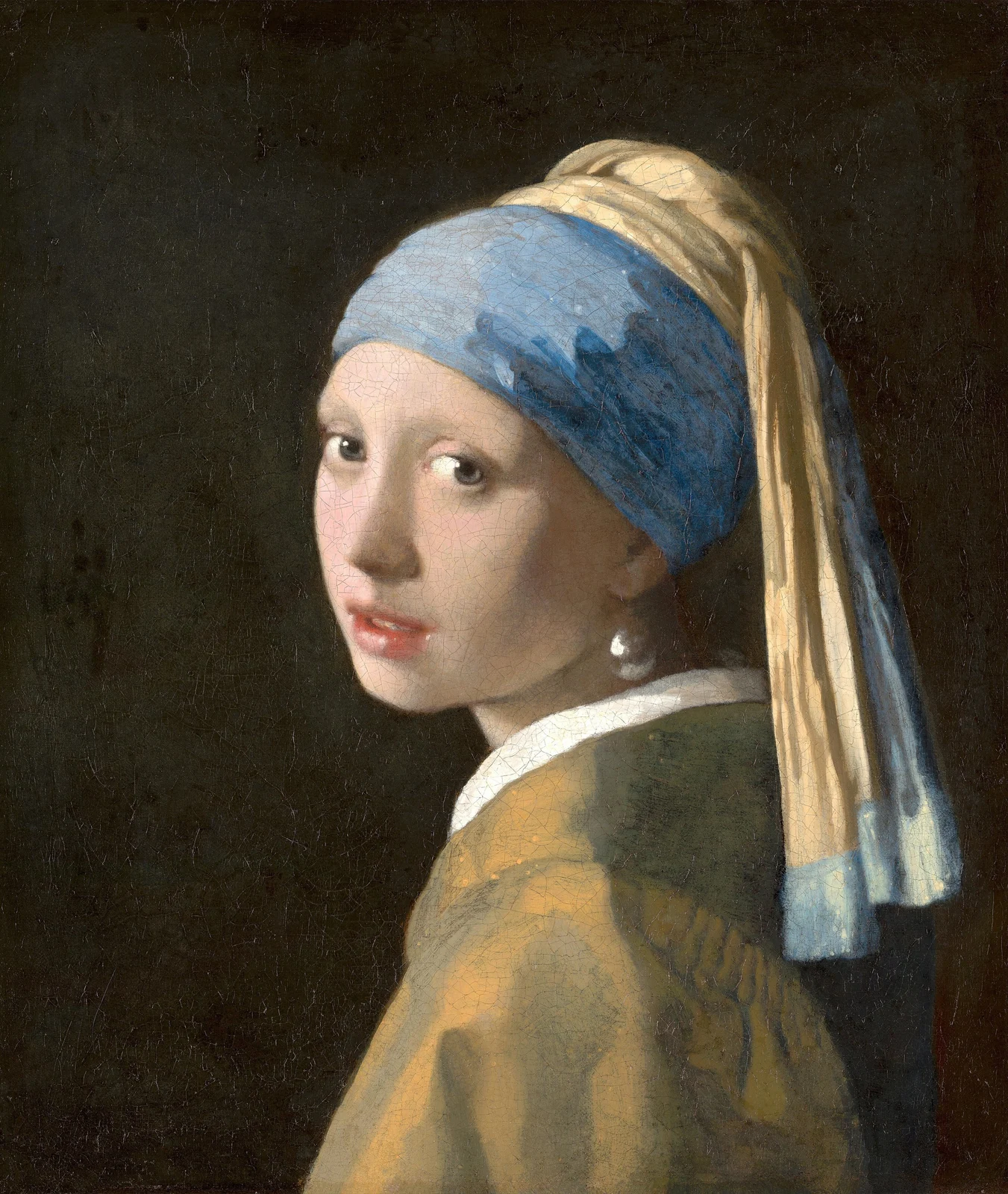
- Original Title
- Meisje met de parel (historically Een Tronie in Antique Klederen)
- Artist
- Johannes Vermeer (1632–1675)
- Date
- c. 1665
- Medium & Support
- Oil on fine-weave linen canvas over a brownish-gray chalk and earth ground
- Dimensions
- 44.5 × 39 cm (17.5 × 15.4 in)
- Repository
- Mauritshuis, The Hague (Gallery 15, Inv. no. 670)
- Provenance
- Likely painted for Delft patron Pieter Claesz van Ruijven and Maria de Knuijt; Lot 38 in the 1696 Jacob Dissius sale in Amsterdam (36 guilders); purchased for 2 guilders 30 cents by Arnoldus Andries des Tombe at The Hague in 1881 and bequeathed to the Mauritshuis in 1902
- Diagnostic Conservation
- 1994 restoration led by Jørgen Wadum and Nicola Costaras; 2018–2020 "The Girl in the Spotlight" non-invasive macro-XRF, OCT, and digital microscopy project led by Abbie Vandivere
Hailed as the “Northern Mona Lisa,” this crowning tronie of the Dutch Golden Age revolutionized how Western art captures light and human presence. Rather than a formal commissioned portrait, the canvas arrests a suspended fraction of a second, using velvety chiaroscuro and rare lapis lazuli glazes to forge an unguarded bond with the viewer. Technical imaging confirmed its audacious optical illusion: the pearl possesses no contour hook or outline, conjured instead by two floating brushstrokes of lead-white paint.
Material & Compositional Details
Enlarged regions from the Mauritshuis photograph highlighting Vermeer’s two-stroke pearl illusion, crushed lapis lazuli headscarf glazes, and pointillé light reflections.
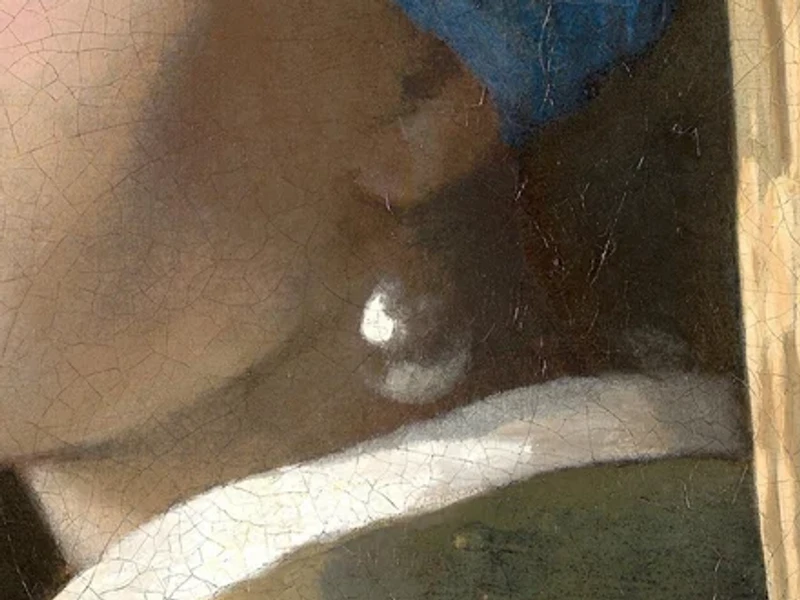
The Two-Brushstroke Pearl Illusion
Vermeer painted zero metal hook and no dark outline around the teardrop jewel. Two detached strokes of lead-white paint (a crisp comma for the window reflection and a muted glow off the white collar) convince the eye a solid silver pearl hangs in shadow.
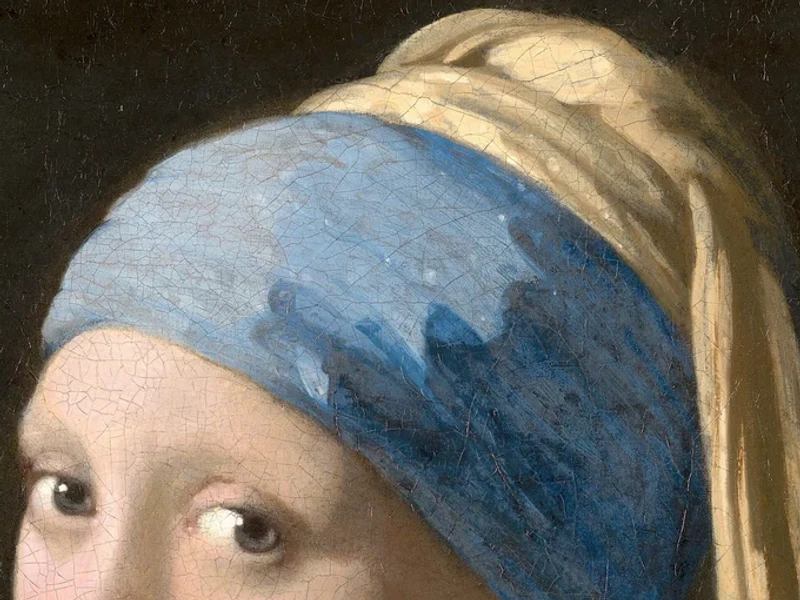
Natural Ultramarine & Lead-Tin Yellow
To drape her headscarf in an exotic eastern band, Vermeer glazed costly natural ultramarine ground from Afghan lapis lazuli over blue underlayers, knotted into luminous lead-tin yellow fabric cascading down her shoulder.
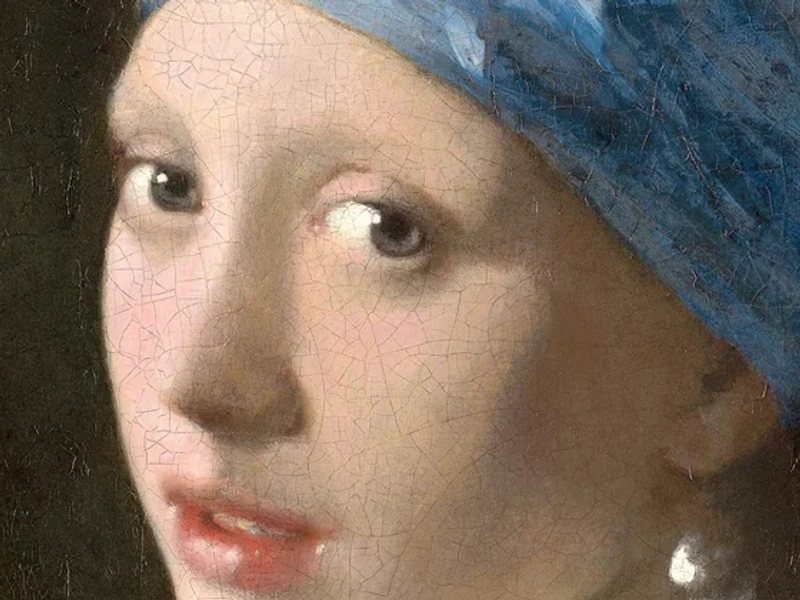
Moist Parted Lips & Sfumato Bridge
Instead of drawing an ink-like line along the shadowed nose, Vermeer let pale peach flesh transition seamlessly into warm half-shadow while sealing the parted cochineal lips with tiny white corner highlights.
Step close to Girl with a Pearl Earring in Room 15 of the Mauritshuis and the painting’s quiet magic begins to dissolve into bare paint marks. At gallery distance, a young woman turns abruptly over her shoulder to meet your gaze, illuminated by an outsized pearl catching crisp northern window light; inches from the surface, there is no earring wire attaching the jewel to her ear, no solid sphere beneath the shine, and no sharp contour separating the left bridge of her nose from her illuminated cheek.
An Anonymous Delft Tronie, From the 1696 Dissius Sale to a Two-Guilder Rescue
Contrary to two centuries of romantic legend linking the sitter to Vermeer’s eldest daughter Maria or a secret household muse, curators agree Girl with a Pearl Earring was never intended as a factual commissioned portrait of an identifiable citizen of Delft. Seventeenth-century Dutch workshops cultivated a dedicated market for the tronie: a character study of a head in historical or fanciful foreign dress, designed to showcase a painter’s command of expression, clothing texture, and optical lighting rather than likeness. In May 1696, when the estate of Delft printer Jacob Dissius (son-in-law of Vermeer’s principal collectors Pieter Claesz van Ruijven and Maria de Knuijt) went under the gavel in Amsterdam, Lot 38 was cataloged concisely in antique costume ("Een tronie in antique klederen, ongemeen konstig") and sold for 36 guilders.
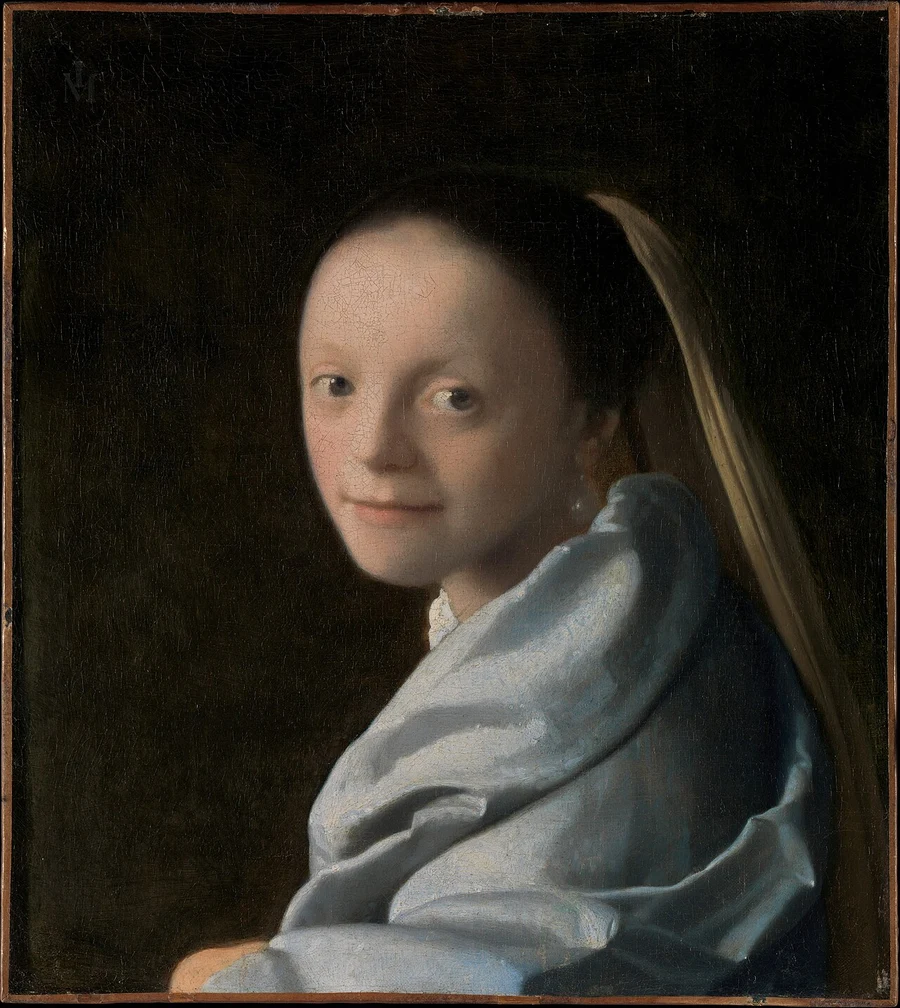
Over the next two centuries, Girl with a Pearl Earring slipped out of sight while Vermeer’s name all but disappeared from European canons. In 1881, layered under darkened varnish and street grime, the unattributed canvas crossed the block at an estate auction in the Venduhuis der Notarissen in The Hague. Urged on by conservation advocate Victor de Stuers, collector Arnoldus Andries des Tombe placed the winning bid of 2 guilders plus 30 cents buyer’s premium, saving the panel from export. Following cleaning, the faded varnish lifted to reveal an artist’s monogram at upper left (IVMeer), and upon Des Tombe’s death in 1902, his bequest entered the Mauritshuis permanently.
Crushed Afghan Lapis Lazuli, Lead-Tin Yellow, and a Pearl Without a Hook
Material science conducted at the Mauritshuis overturned the tidy cliché of Vermeer as a provincial painter working modestly inside one Delft town house: every major tube and glaze in Girl with a Pearl Earring testifies to global seventeenth-century maritime trade. Isotopic analysis of the pure lead white forming her collar and facial highlights traced the lead ore to northern England. Cochineal carmine glazes animating her parted crimson lips originated from scale insects harvested off prickly pear cacti in Mexico and South America. Most extravagantly, the radiant azure of her wound headscarf relied on natural ultramarine pulverized from lapis lazuli quarried in Badakhshan (modern Afghanistan), an imported stone so valuable Vermeer conserved it over a cheaper mineral underlayer even for an unsigned tronie.
Just as daring is the eponymous pearl itself, measuring nearly half an inch tall across the finished composition. Even real baroque pearls rarely reach that volume in period jewelry, leading many mineralogists to suspect a teardrop silver earring burnished to a mirror polish, or simply an artistic enlargement of Vermeer’s light physics. Macro-microscopy proves Vermeer built the sphere purely through light suggestion: an intense white window stroke at upper left, a soft translucent lower crescent echoing her stiff linen collar below, and bare shadow where a brass clasp or wire ought to pierce her earlobe.
Arrested Motion: Sfumato Contours and Pointillé Highlights
To sustain the illusion that the sitter is caught in motion rather than frozen on a wooden posing chair, Vermeer stripped away hard drawing lines wherever air meets sunlit form. Across her illuminated cheekbone, nose ridge, and jawline, there is no dark ink outline; instead, subtle warm brown-gray half-shadows feather into pale peach highlights, an optical softening reminiscent of Leonardo da Vinci’s sfumato. Crucially, the sitter’s bright white collar acts as an active secondary mirror, bouncing cool upward fill light right under her shadowed chin and illuminating the underside of the floating pearl.
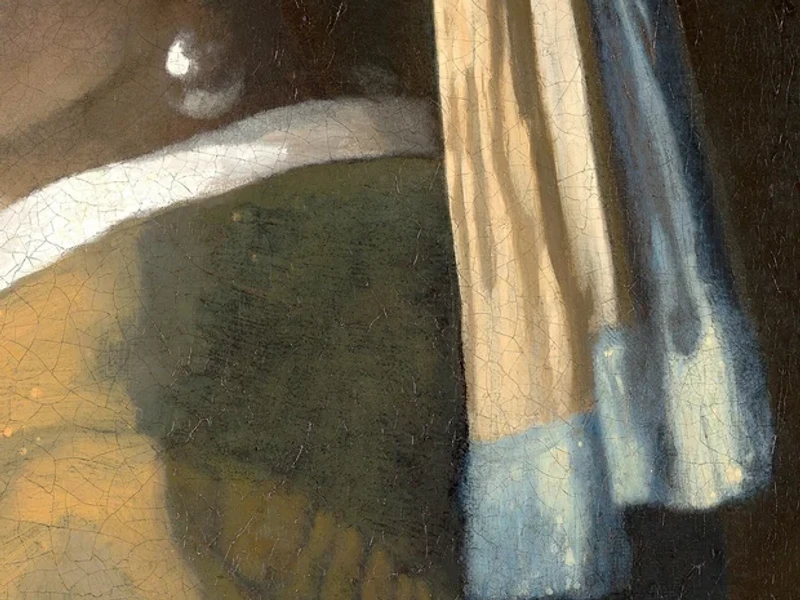
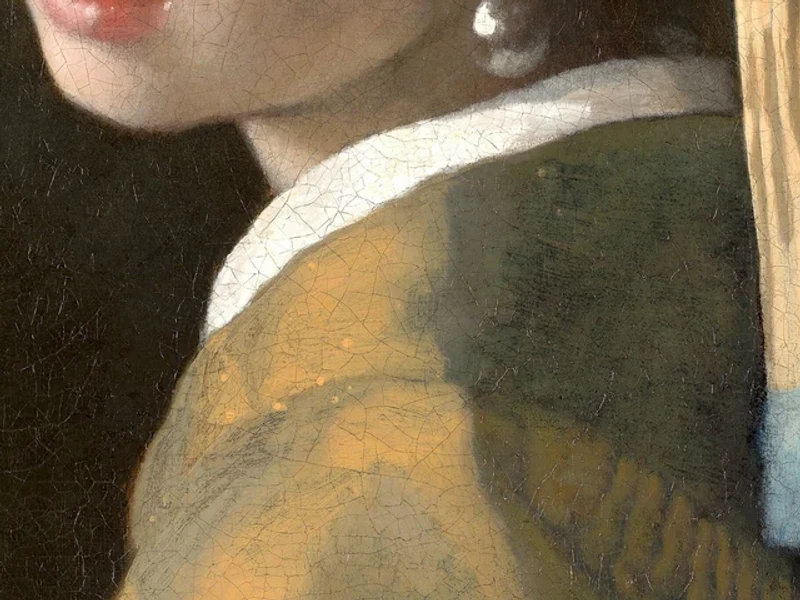
Vermeer paired that soft atmospheric modulation with tiny raised dots of nearly unblended light pigment (pointillé), a signature optical signature seen across his Delft career from sunlit kitchen crumbs in The Milkmaid (c. 1658) to this headscarf’s cascading golden tail. Micro-dots of bright pigment sit right beside the damp corners of her eyes, along the sheen of her moistened lips, and down the fringed tip of the turban tail trailing over her ochre-brown jacket, creating a luminous vibration even under dim Dutch interior candles.
Inside the 1994 Restoration and the 2018 "Girl in the Spotlight" Project
For generations, historians described Girl with a Pearl Earring as floating against an empty, stark black void that separated her cleanly from any Dutch interior room. During the 1994 conservation treatment directed by Jørgen Wadum and Nicola Costaras, microscopic pigment scrapes suggested the backdrop originally held subtle tonal richness. Yet it took the 2018 "The Girl in the Spotlight" diagnostic campaign led by Mauritshuis conservator Abbie Vandivere alongside NICAS research scientists, operating inside a specially built glass laboratory in Gallery 15, to reconstruct Vermeer’s vanished studio setting non-invasively.
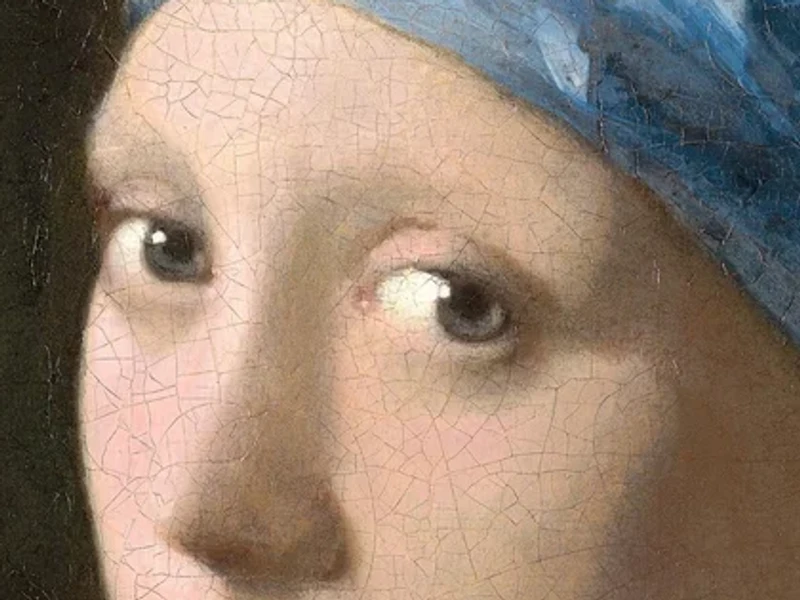
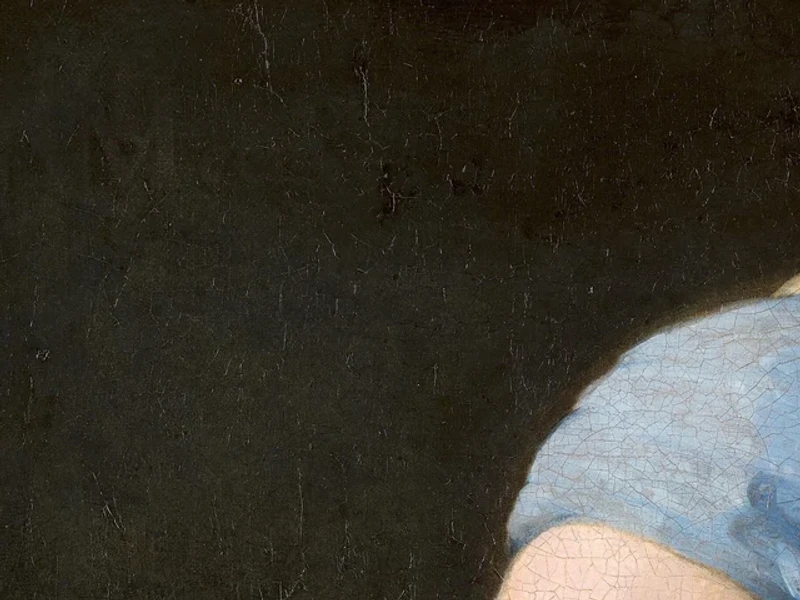
Combining macro X-ray fluorescence (MA-XRF), reflectance imaging spectroscopy, optical coherence tomography (OCT), and 3D microscopy, Vandivere’s team mapped the canvas layer by layer from priming to final varnish. Scans uncovered that the "empty black void" was once a rich, translucent green curtain painted behind the girl in diagonal drapery folds. Over an opaque carbon-black underlayer, Vermeer glazed organic blue indigo mixed with yellow luteolin dye extracted from weld plants; over three and a half centuries, those fugitive organic colorants bleached and oxidized into darkened bronze-black, leaving only tiny trace chemistry along the upper corners. Infrared and high-resolution microscopy simultaneously debunked the long-held myth that Vermeer painted her without eyelashes, revealing delicate brown hairs around both eyes obscured to casual sight by craquelure and time.
Precedents & Influences Behind the Painting
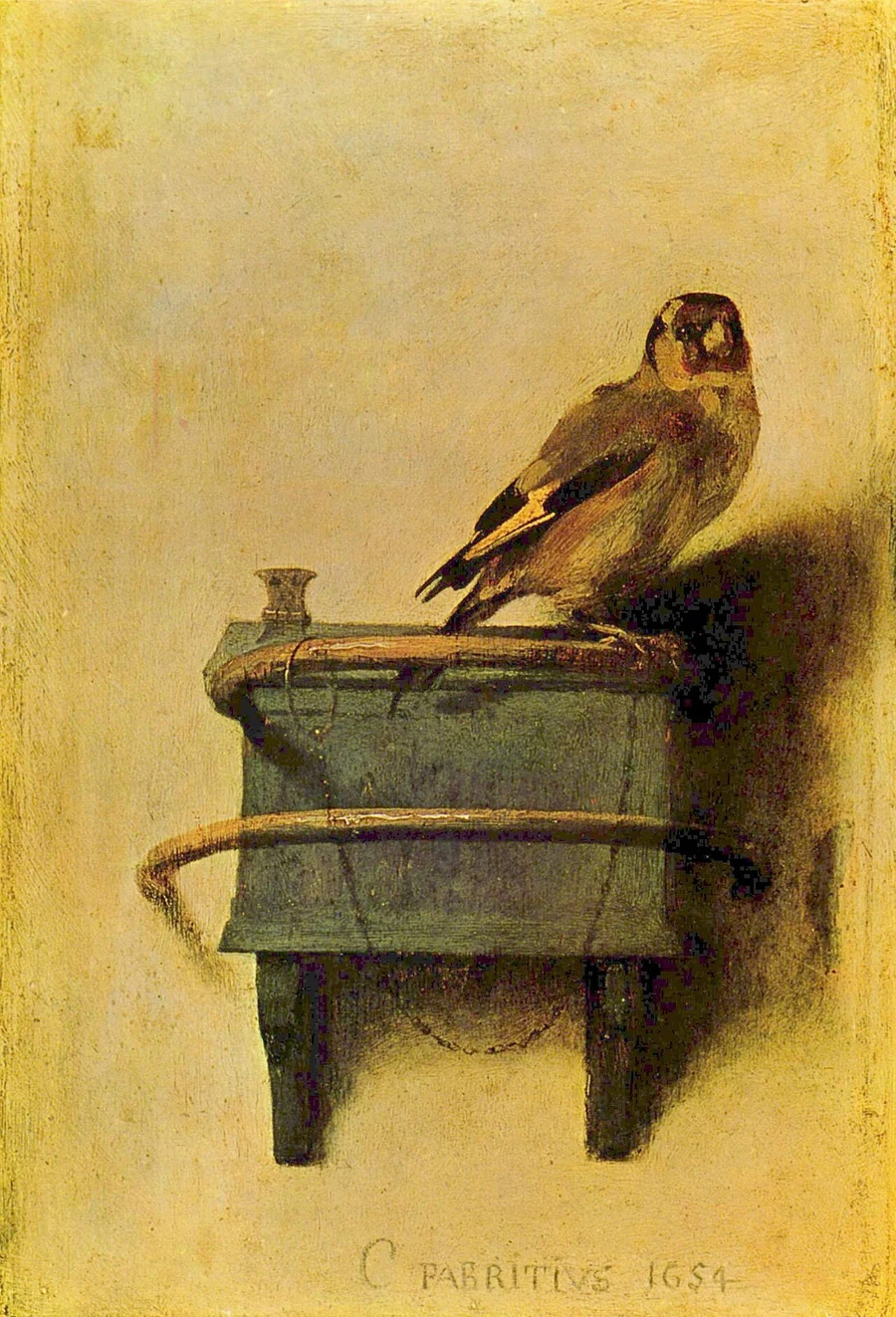
The Dutch tronie grew out of Haarlem and Amsterdam studios in the 1620s and 1630s, led most forcefully by Rembrandt van Rijn, whose self-portraits, bearded elders, and turbaned figures used bold tenebrism and fanciful studio props to study fleeting human emotion. Even when Rembrandt tackled monumental civic theater in works such as The Night Watch (1642), he turned figures mid-motion toward the viewer with theatrical contrasts of shadow and gleam, an approach his star Delft pupil Carel Fabritius distilled into razor-focused intimacy during the early 1650s before tragically dying in the 1654 Delft gunpowder explosion.
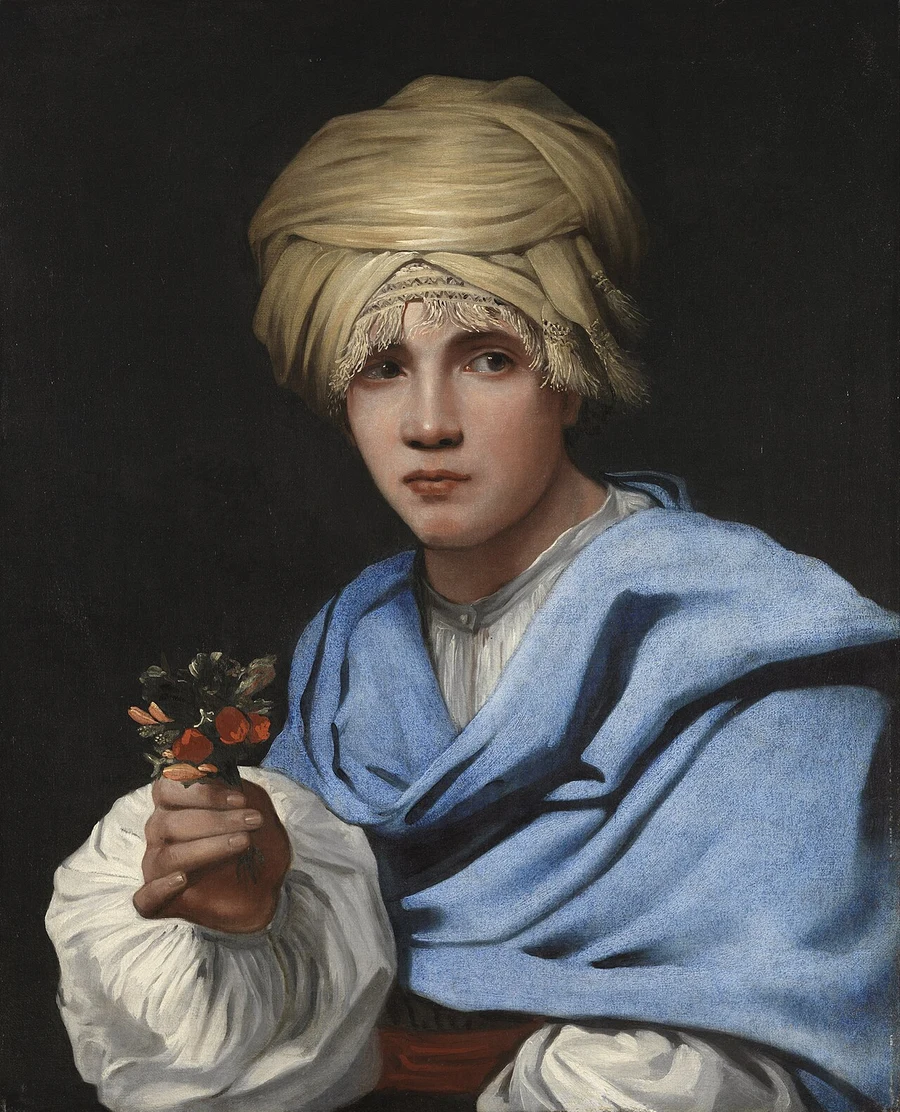
Just as telling is the international Netherlandish tronie dialogue exemplified by Brussels-born painter Michael Sweerts, who returned from Rome in the late 1650s painting smooth-skinned youths wrapped in wound eastern turbans and rare ultramarine cloaks set against hushed dark voids. Sweerts’s Boy in a Turban Holding a Nosegay (c. 1658–1661) shares the same blue-and-yellow headgear drama and intimate psychological distance that Vermeer perfected around 1665, trading Sweerts’s sculptural drapery pleats for translucent glazing and effortless northern daylight.
Onward Influence
For nearly two hundred years after Vermeer’s death in 1675, his oeuvre scattered silently under mistaken attributions while Rembrandt held unchallenged sway over European collectors. Everything reversed in 1866 when French critic Théophile Thoré-Bürger published a landmark monograph series in the Gazette des Beaux-Arts celebrating "the Sphinx of Delft," cataloging his cool mineral daylight, clean geometry, and poetic stillness alongside companion masterpieces in the Netherlands such as The Milkmaid (c. 1658) and Rembrandt’s dramatic The Night Watch (1642).
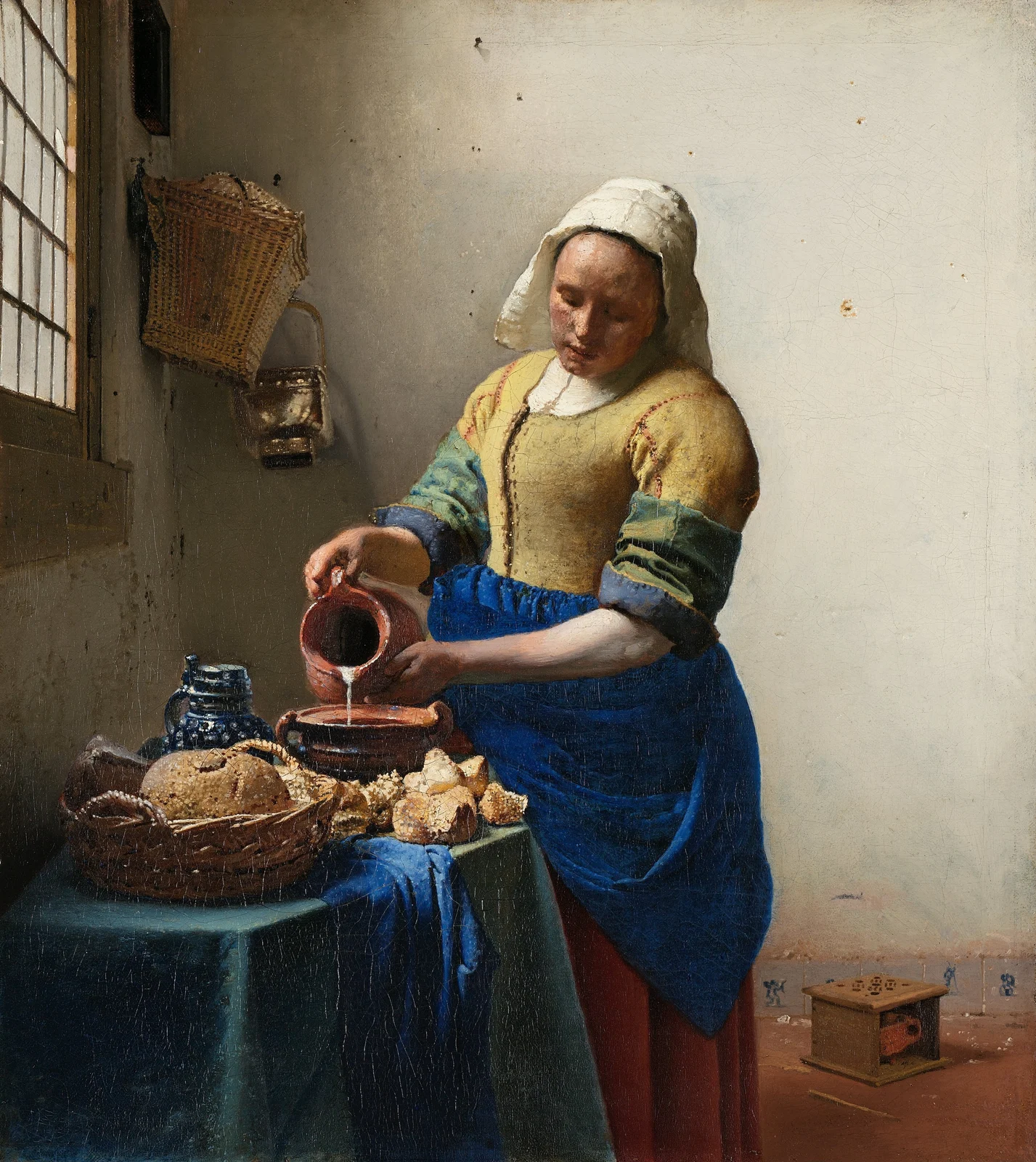
Johannes Vermeer, The Milkmaid, c. 1658 (Rijksmuseum). Features the same natural Afghan lapis lazuli ultramarine, lead-tin yellow contrast, and sparkling pointillé light drops seen in Girl with a Pearl Earring. Explore this work in our collection →
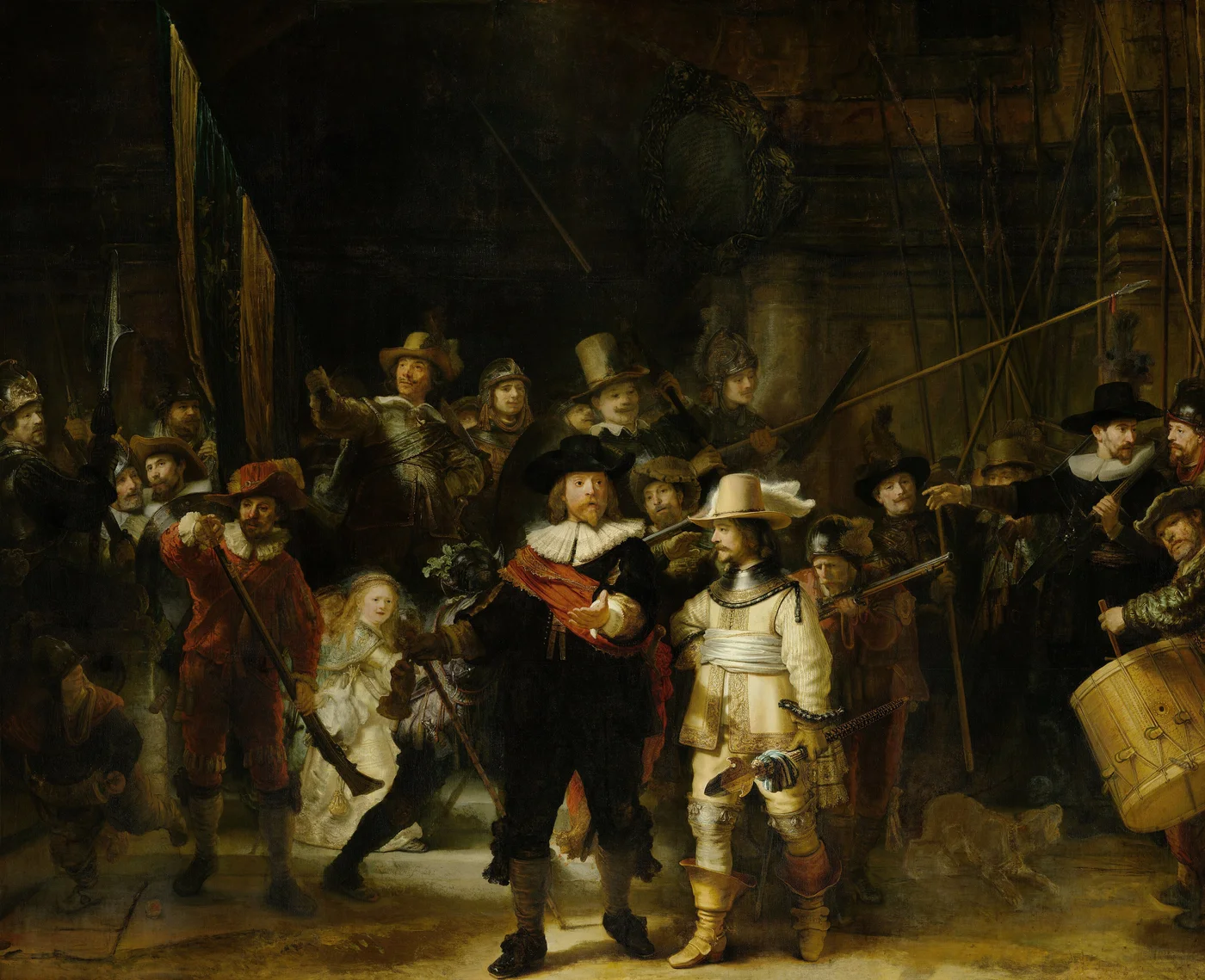
Rembrandt van Rijn, The Night Watch, 1642 (Rijksmuseum). Dutch Golden Age chiaroscuro and kinetic mid-turn drama laid the stylistic foundation from which Delft artists distilled quiet chamber luminosity. Explore this work in our collection →
Once Thoré-Bürger’s rediscovery ignited modernist Europe, painters and novelists raced to study Vermeer’s uncanny color harmony. Writing from Arles in July 1888 to Émile Bernard, Vincent van Gogh marveled at how Vermeer fused lemon yellow, pale blue, and pearl gray with almost no muddy black shadows, directly informing Van Gogh’s own cobalt-and-gold nocturnal contrasts. French writers led by Marcel Proust elevated Vermeer’s pure patch of yellow pigment and serene gaze to artistic absolutes in In Search of Lost Time, while late nineteenth-century French colorists captured sunlit figures and intimate glances akin to Renoir’s Two Sisters (On the Terrace) (1881). Cleaned in 1994 and toured worldwide during Mauritshuis renovations before Tracy Chevalier’s 1999 novel cemented its global renown, Girl with a Pearl Earring now stands beside Leonardo’s Mona Lisa as Western painting’s quintessential psychological riddle.
Carry the Painting & Its Curated Description
Every keepsake below features Johannes Vermeer’s Girl with a Pearl Earring on the front and its curated description on the reverse, with free US shipping.
 $35
Canvas Tote Bag
15" × 16" Natural Canvas
 $22
Ceramic Mug
11oz White Glazed Ceramic
 $38
Throw Pillow
16" × 16" Woven Canvas w/ Insert
 $28
Hardcover Journal
5.75" × 8" Ruled Pages (150pp)
 $18
Ceramic Ornament
3" Round Porcelain w/ Gold Cord
Frequently Asked Questions About Girl with a Pearl Earring
Who was the girl in Vermeer’s Girl with a Pearl Earring, and is it a true portrait?
She was an unnamed sitter posing for a Dutch Golden Age character study (a tronie) rather than a commissioned portrait meant to preserve a specific citizen’s identity. Neither contemporary estate inventories nor conservation archives identify her name, as the painting foregrounds her exotic wound headscarf, glistening jewelry contrast, and fleeting over-the-shoulder glance.
Is the earring in Girl with a Pearl Earring painted from a real pearl?
Probably not an authentic natural pearl of that size, which would have been astronomically rare and heavy for an everyday teardrop stud. Mineral and jewelry specialists frequently suggest either a polished teardrop tin or silver bead (or an artistic enlargement painted from memory), rendered purely as two floating lead-white brushstrokes without any wire hook attaching to the ear.
Why does the background of Girl with a Pearl Earring look solid black today?
Although the space behind her appears to be an empty dark void today, 2018–2020 macro-XRF and hyperspectral imaging revealed she originally posed before a deep translucent green curtain with diagonal folds. Over three and a half centuries, Vermeer’s organic green glaze of indigo and yellow weld dye faded and degraded, leaving only the dark charcoal-rich underpaint visible to the naked eye.
How did the Mauritshuis acquire Girl with a Pearl Earring for just two guilders?
When Vermeer was still relatively unknown in 1881, art collector Arnoldus Andries des Tombe spotted the dirty, unattributed painting at an estate auction at the Venduhuis der Notarissen in The Hague on the advice of Victor de Stuers. Des Tombe bought it for 2 guilders plus 30 cents buyer’s premium, had it cleaned (revealing Vermeer’s signature), and bequeathed it to the Mauritshuis upon his death in 1902.