The Great Wave off Kanagawa: Prussian Blue Chemistry, Keyblock Wear, and a Quarter Century in the Making
How Katsushika Hokusai fused Edo woodblock craft, Dutch-imported Berlin blue pigment, and Western horizon geometry into an emblem of human nerve against elemental force.
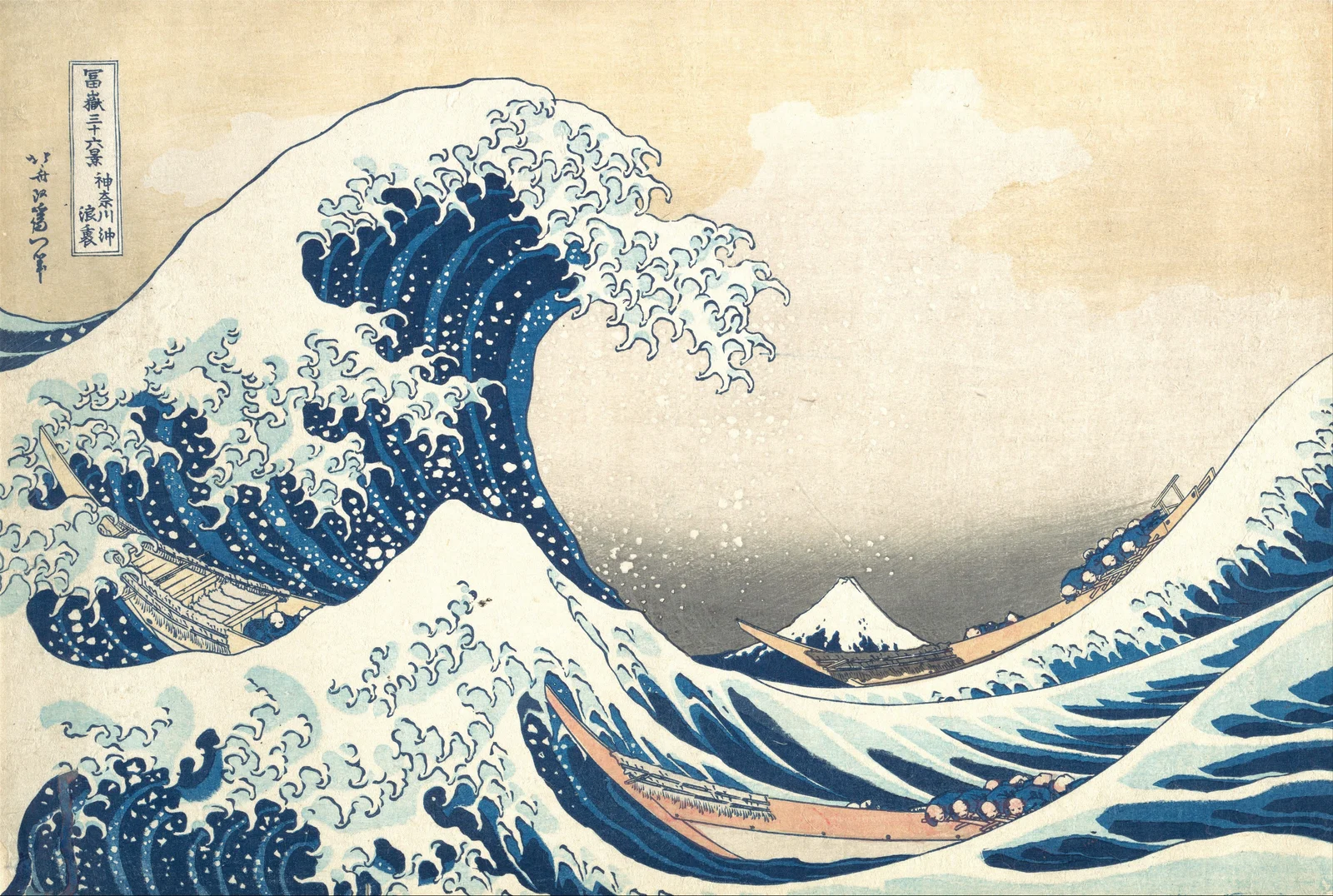
- Original Title
- Kanagawa oki nami ura (Under the Wave off Kanagawa), from Fugaku sanjūrokkei (Thirty-six Views of Mount Fuji)
- Artist
- Katsushika Hokusai (1760–1849); published by Nishimuraya Yohachi (Eijudō)
- Date
- c. 1830–1832
- Medium & Support
- Polychrome woodblock print (nishiki-e); ink and color (synthetic Prussian blue and indigo) on paper
- Dimensions
- 25.7 × 37.9 cm (10 1/8 × 14 15/16 in), horizontal ōban format
- Repository
- The Metropolitan Museum of Art, New York (Department of Asian Art, Acc. no. JP1847)
- Provenance
- Published in Edo (Tokyo) c. 1830–1832 by Nishimuraya Yohachi (Eijudō); entered the H. O. Havemeyer Collection and bequeathed to The Metropolitan Museum of Art by Mrs. H. O. Havemeyer in 1929
- Diagnostic Conservation
- 2020 Met spectroscopic analysis (Marco Leona) revealing layered Prussian blue and traditional indigo; British Museum forensic study of 110+ surviving impressions (Capucine Korenberg, 2023) establishing eight states
An immortal icon of Japanese ukiyo-e printmaking, this masterwork revolutionized global visual culture and directly inspired European Impressionism. Carved across multiple cherrywood blocks, the composition merges traditional Edo design with Western linear perspective and newly imported Prussian blue pigment, giving the water unprecedented tonal depth. Through masterful asymmetrical balance, the towering, foam-clawed crest frames the distant sacred peak at a dramatic low horizon, contrasting human fragility against nature’s enduring power.
Material & Compositional Details
Enlarged regions from The Metropolitan Museum of Art print highlighting Hokusai’s layered Prussian blue pigments, framed distant horizon, and thirty bracing crewmen.
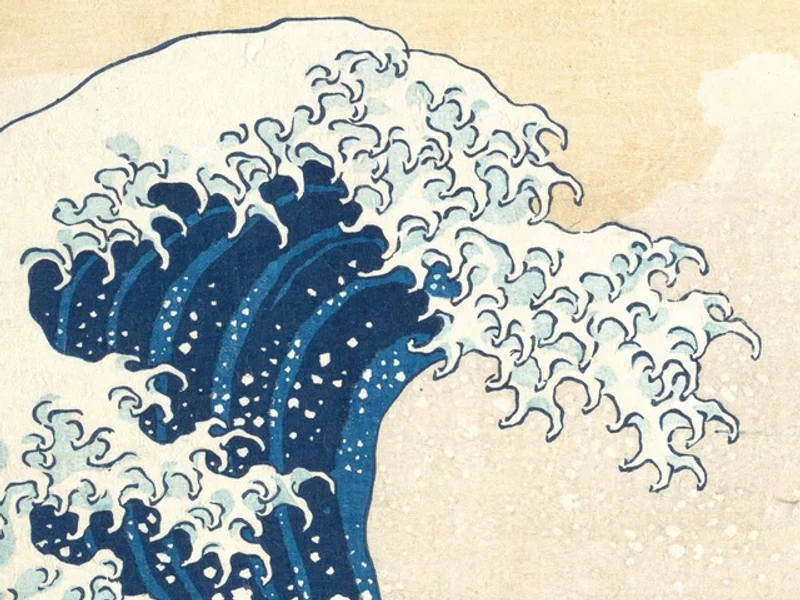
Foam Talons & Layered Prussian Blue
Spectroscopic scans at The Met proved Edo printers did not simply abandon organic dye: they blended traditional indigo with imported Prussian blue (bero-ai) for deep darks, then overprinted pure Prussian blue to preserve radiant mid-ocean translucency.
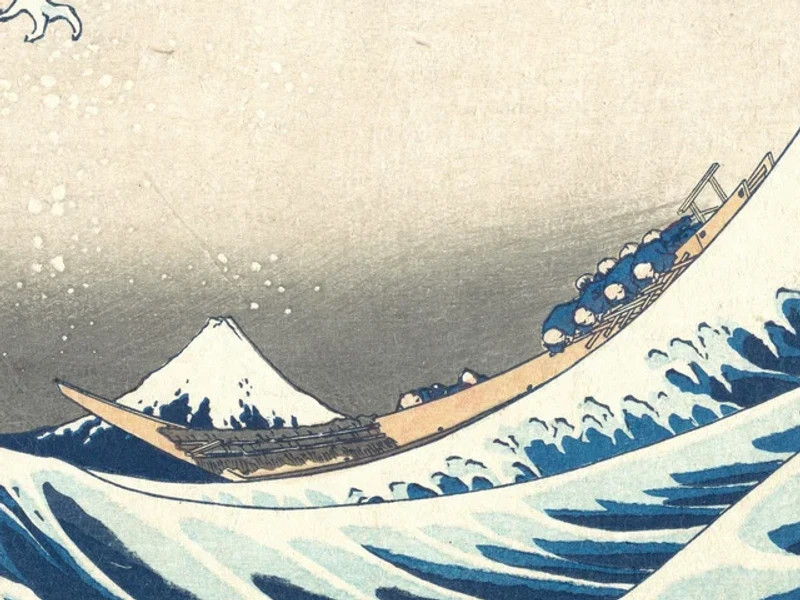
Sacred Peak Pinned Inside the Horizon Trough
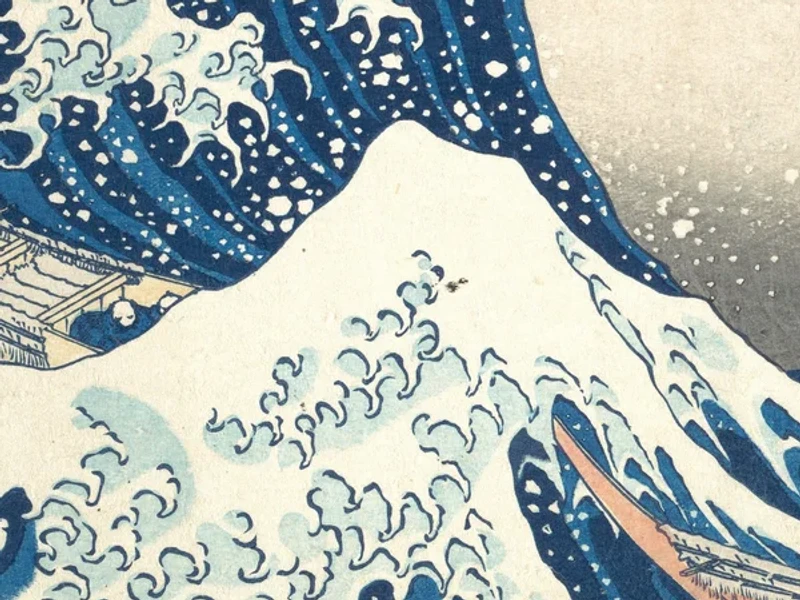
By dropping the horizon far below center, Hokusai frames snow-capped Mount Fuji beneath a secondary foreground breaker whose icy geometry mimics the mountain’s own volcanic slope.
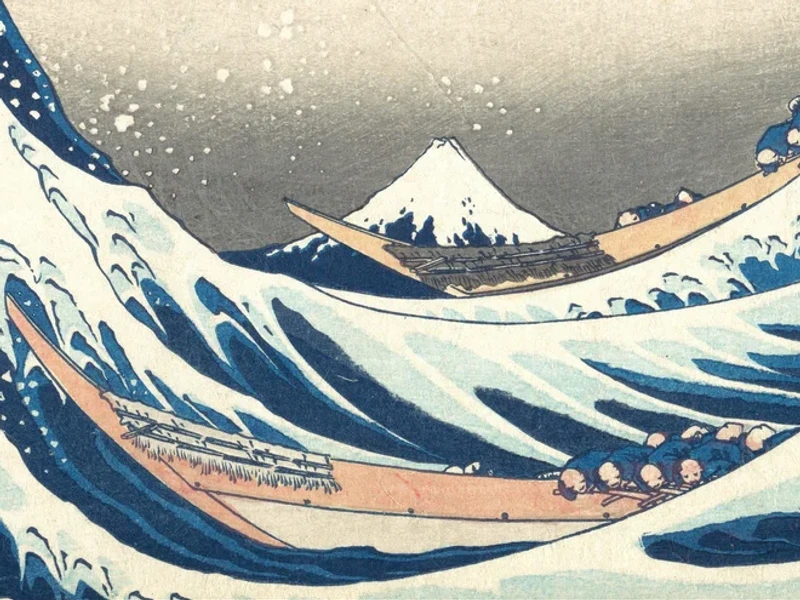
Eight Rowers and Two Relief Crew per Boat
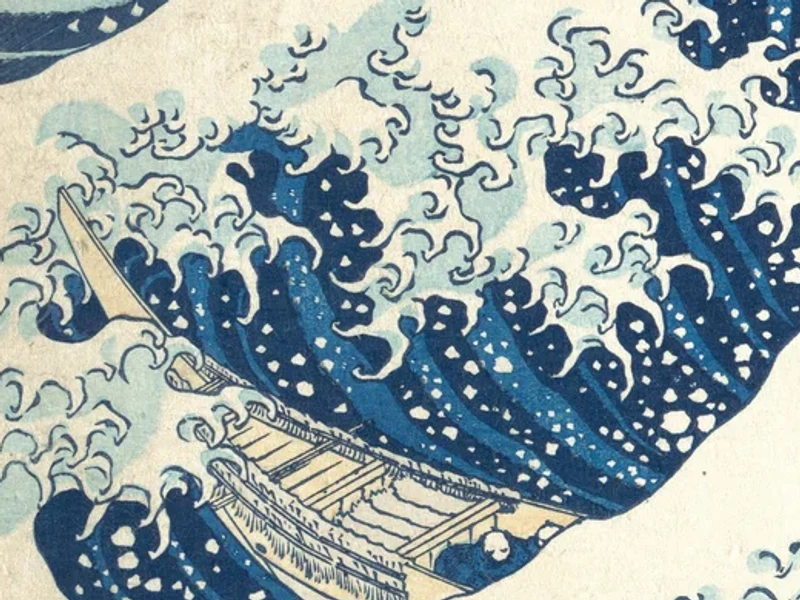
Thirty fishermen bend low along three slender oshiokuri-bune cargo skiffs used to race live fish into Edo markets, transforming everyday commercial sea transit into an allegory of collective survival.
At first glance, Katsushika Hokusai’s The Great Wave off Kanagawa reads like a frozen flash of storm violence: a looming claw of Pacific seawater poised to smash three fishing skiffs while Mount Fuji sits minuscule beneath the swell. Yet the sheet was never a solitary aristocrat’s brush painting, nor an overnight flash of spontaneous genius. Created when Hokusai was around seventy years old and mass-printed in Edo across thousands of affordable paper sheets, the composition distills more than twenty-five years of seascape prototypes, European perspective treatises, and a newly arrived synthetic blue pigment smuggled into commercial circulation through Nagasaki.
Opening Sheet of Thirty-Six Views of Mount Fuji, From Edo Stalls to the Havemeyer Bequest
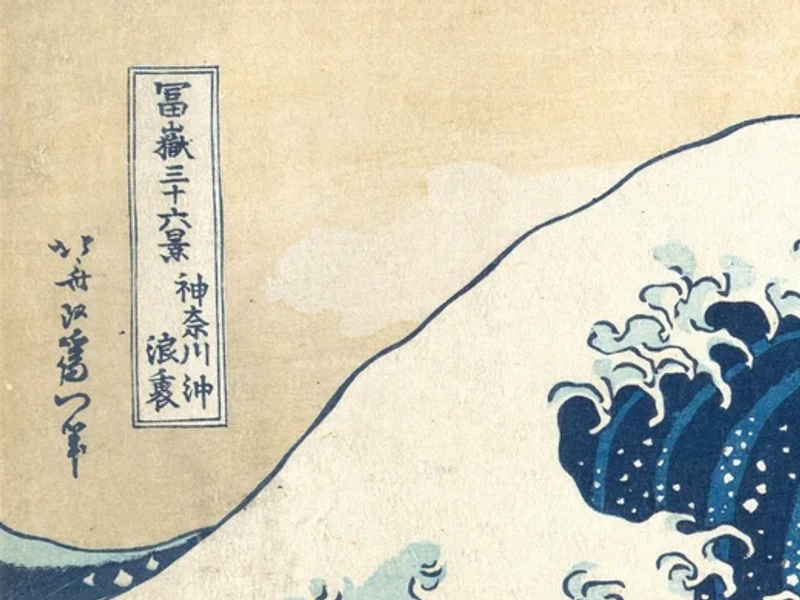
Titled Kanagawa oki nami ura ("Under the Wave off Kanagawa") inside the framed rectangular strip at upper left, this print opened Katsushika Hokusai’s landmark series Fugaku sanjūrokkei (Thirty-six Views of Mount Fuji). Published around 1830 to 1832 by Nishimuraya Yohachi under the trade house name Eijudō, the horizontal ōban sheet was carved into wooden printing matrices and sold cleanly at street-level Edo print shops for everyday city merchants and travelers. To the left of the title cartouche runs Hokusai’s proud artistic inscription: Hokusai aratame Iitsu hitsu ("From the brush of Hokusai, who changed his name to Iitsu"), marking one of his boldest late-life artistic reinventions at age seventy.
While aristocratic collectors originally favored silk scrolls and single-brush screens, Hokusai’s commercial woodblock sheets crossed oceanic trade routes within decades of the printmaker’s death in 1849. Parisian painters, critics, and dealers prized the sheets during the late nineteenth-century wave of Japonisme, and collectors Henry Osborne Havemeyer and Louisine Havemeyer assembled superb early impressions in New York. Bequeathed to The Metropolitan Museum of Art in 1929 alongside nearly three thousand works in the Havemeyer estate, Met impression JP1847 stands today as the flagship American touchstone of Edo ukiyo-e landscape printmaking.
Bero-ai: Imported Prussian Blue and Cherrywood Registration Blocks
What immediately stunned Edo buyers in 1831 was not merely the dramatic scale of Hokusai’s crest, but the hypnotic intensity of its blues. Before the late 1820s, Japanese ukiyo-e workshops relied heavily on traditional indigo and fugitive organic dayflower dye (tsuyukusa), which yielded soft, muted tints prone to washing out in sunlight. Newly imported from Europe via Dutch and Chinese trading ships at Nagasaki came synthetic Prussian blue (known in Japan as bero-ai, or "Berlin blue"), a stable chemical pigment able to hold crisp tonal gradations across light mist and deep trench shadow.
In The Met’s 2020 spectroscopic investigation ("The Great Wave: Anatomy of an Icon"), scientist Marco Leona demonstrated that Eijudō’s printers approached this imported chemical with remarkable technical subtlety rather than crudely replacing native materials. Color analysis showed that craftsmen physically blended Prussian blue with organic indigo to print the bold structural outlines and striped interior troughs, then overprinted translucent layers of pure Prussian blue across key zones to preserve saturated depth without flattening the foaming surface. Tight registration notches carved into each cherrywood block aligned pale cream boats, subtle gray ink-wash sky gradients (bokashi), and sweeping blue currents on heavy mulberry paper.
Low Horizons, Fractals of Foam, and Three Oshiokuri-bune in a Moving Trench
Structurally, Hokusai builds almost unbearable narrative tension by playing asymmetric dynamic curve against geometric stillness. Sweeping across two-thirds of the horizontal sheet, the mammoth ocean swell curves upward from lower left and hooks downward like an articulated predator’s paw. Instead of placing spectators high above the bay, Hokusai drops the horizon toward the bottom quarter of the paper, pulling viewers down into the wet trough between waves. Anchoring that swirling ellipse, minuscule Mount Fuji sits pinned near the right-center dip: visually dwarfed by the foreground water yet geometrically echoing the snow-white breaker immediately before it.
Caught squarely between these colliding walls of water are thirty figures crammed inside three slender wooden hulls. Far from ocean-going warships or leisure barges, these vessels are oshiokuri-bune ("push-through boats"), swift coastal delivery craft engineered to haul live fish from coastal pens off the Izu and Bōsō peninsulas to Edo’s bustling morning fish markets. Each boat carries roughly eight oarsmen seated in pairs alongside two relief helmsmen, their bodies tucked nearly flat beneath curved wooden thwarts. The eerily calm precision of twenty-four arched heads braced for impact turns an everyday working commute across Tokyo Bay into a timeless contest between fragile labor and indifferent sea.
Tracking Eight Sequential States Through Micro-Fractures in the Keyblock
Because Eijudō neither dated nor numbered individual impressions as workers pulled copies off carved hardwood blocks, scholars long debated which museum collections held earliest first-week pulls versus worn late reprints. In her landmark British Museum research chapter ("The making and evolution of Hokusai’s Great Wave," Late Hokusai: Thought, Technique, Society, Legacy, 2023), senior heritage scientist Capucine Korenberg solved the chronology through digital microscopy across more than 110 surviving impressions worldwide. By comparing microscopic line breaks and crushed wood fibers along five anatomical weak points on the carved black keyblock (omizuri), including tiny hairlines in the cartouche border and upper spray outlines, she mapped each surviving copy along a single timeline.
Korenberg’s measurements established eight distinct sequential states across the original woodblocks’ commercial run, documenting how intense manual rubbing (baren pressure against damp paper) gradually blunted delicate ridges and forced publishers to cut three sequential replacement color woodblocks as older planks split. Historians estimate that roughly eight thousand impressions were pulled before the matrices retired, meaning early-state prints at the Met, British Museum, and Art Institute of Chicago retain crisp razor edges along the boat prows and traces of warm pink cloud tint across the sky that vanished completely through wear and light exposure on late editions.
Precedents & Influences Behind the Painting
Far from emerging fully formed in Hokusai’s seventy-first year, The Great Wave culminated a quarter century of compositional experiments tracking boats against violent coastal water. Around 1805, Hokusai designed an oblong woodblock print titled Oshiokuri hatō tsūsen no zu ("Fast Cargo Boat Battling the Waves"), in which long Edo fish-delivery skiffs pitch heavily beneath an ominous curling wall of seawater. In that early work, however, the viewer looks down from an elevated classical scroll vantage point with a high, flat horizon, the sea wall remains an unbroken smooth swell lacking curling talons, and no distant landmark frames human scale.
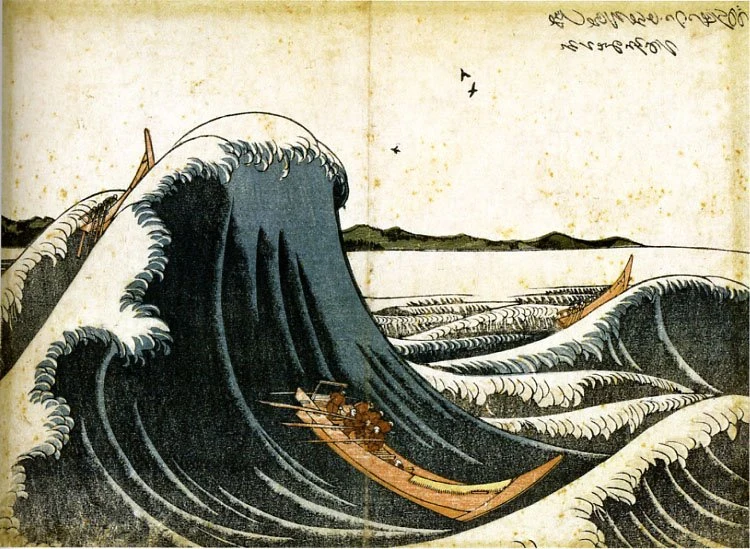
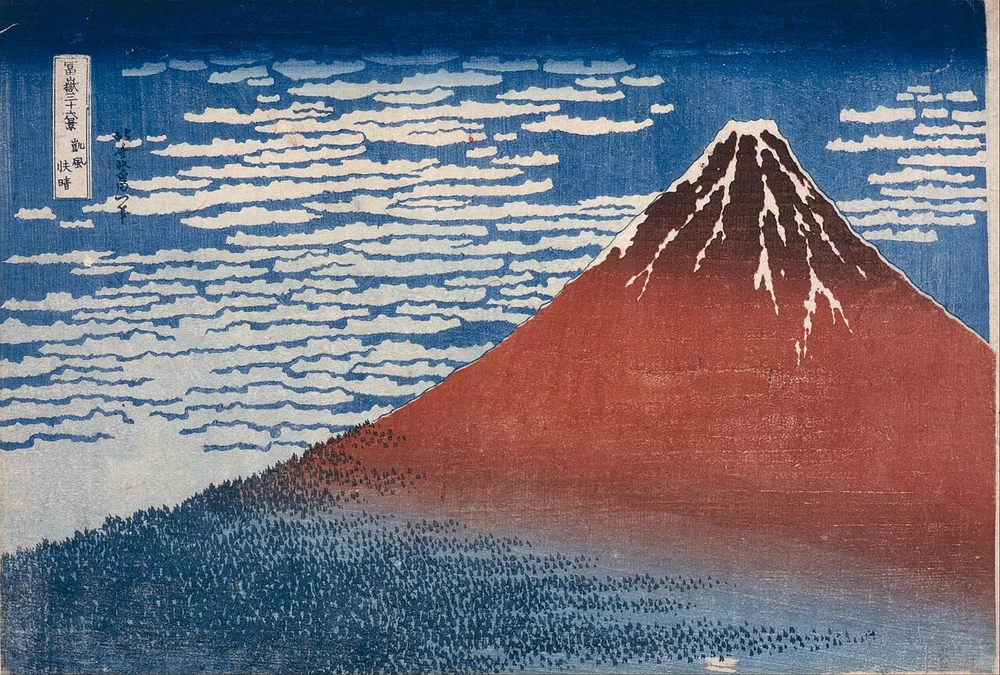
Two cross-cultural currents transformed that 1805 germ into the 1831 masterpiece. Beginning in the 1790s, Hokusai absorbed European linear perspective and copperplate landscape optics through treatises and Dutch engravings circulated by Japanese yōga (Western-style painting) pioneer Shiba Kōkan (1747–1818), learning how a lowered European horizon pulls viewers directly inside the physical crest rather than hovering above it. Simultaneously, thirty years of anatomical sketching across his Hokusai Manga volumes taught him how to animate water with clawed energy. Paired beside companion sheets like Fine Wind, Clear Morning (Red Fuji) in the same 1830–1832 series, imported Prussian blue ink and lowered Western horizon space finally fused East Asian line drama with monumental geometric clarity.
Onward Influence: Japonisme, Van Gogh, Monet, and Debussy’s La Mer
Once Japanese port restrictions eased in the 1850s, sheets from Thirty-six Views of Mount Fuji poured into Paris, transforming Impressionist and Post-Impressionist modernism under the banner of Japonisme. Few European painters articulated Hokusai’s structural lesson as vividly as Vincent van Gogh. Writing from Arles to his brother Theo on or about September 8, 1888 (Letter 676), Van Gogh urged abandoning academic anatomical correctness whenever expressive line could grip the viewer’s chest: "Hokusai makes you cry out the same thing, but in his case with his lines, his drawing, since in your letter you say to yourself: these waves are claws, the boat is caught in them, you can feel it." Nine months later at Saint-Rémy, curling sky eddies and Prussian blue-toned spirals surged directly across Van Gogh’s The Starry Night.
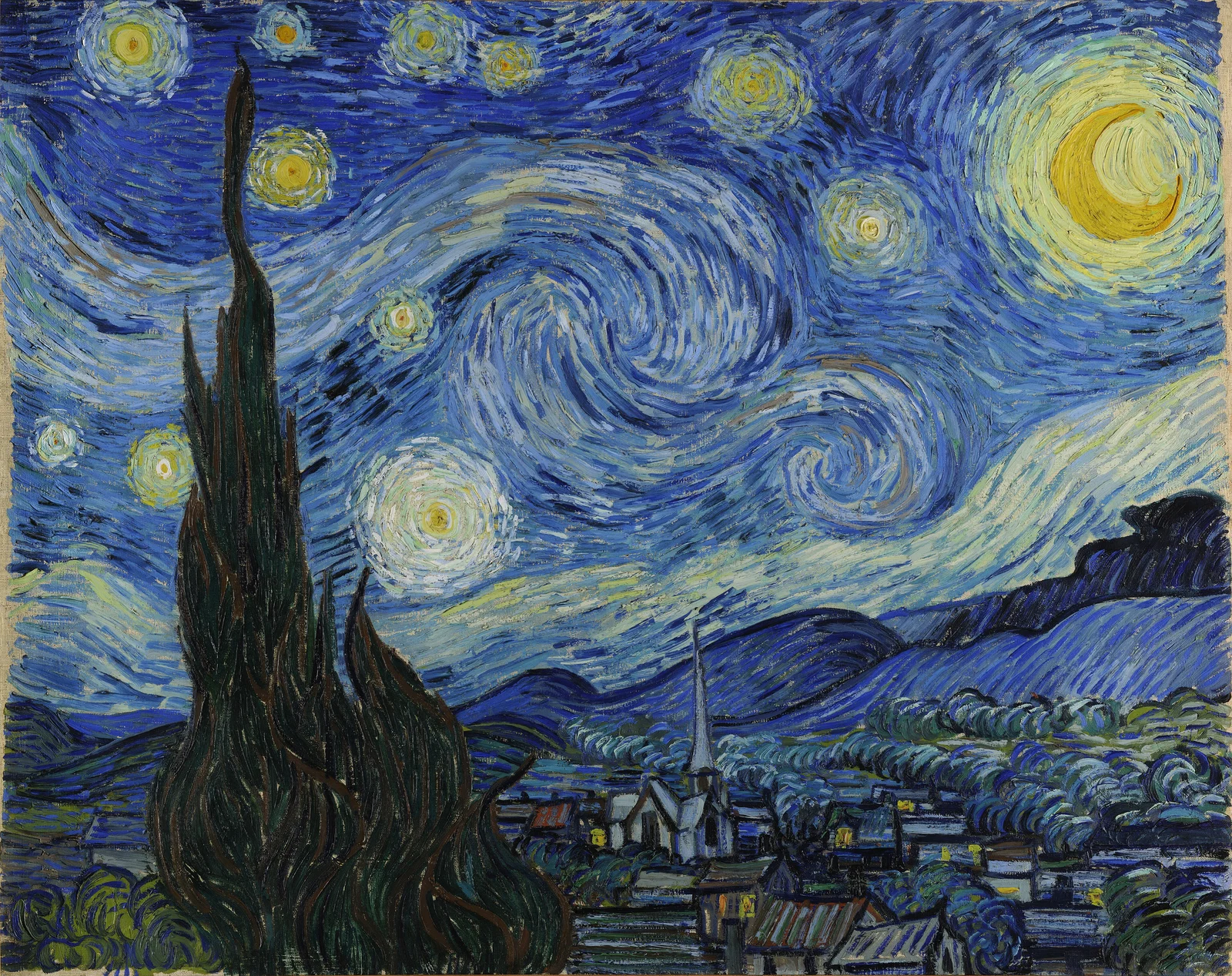
Vincent van Gogh, The Starry Night, 1889 (MoMA, New York). After praising how Hokusai’s lines make waves read like living claws in Letter 676 (September 1888), Van Gogh channelled curling Prussian blue coils and low-horizon drama across his Provence sky. Explore this work in our collection →
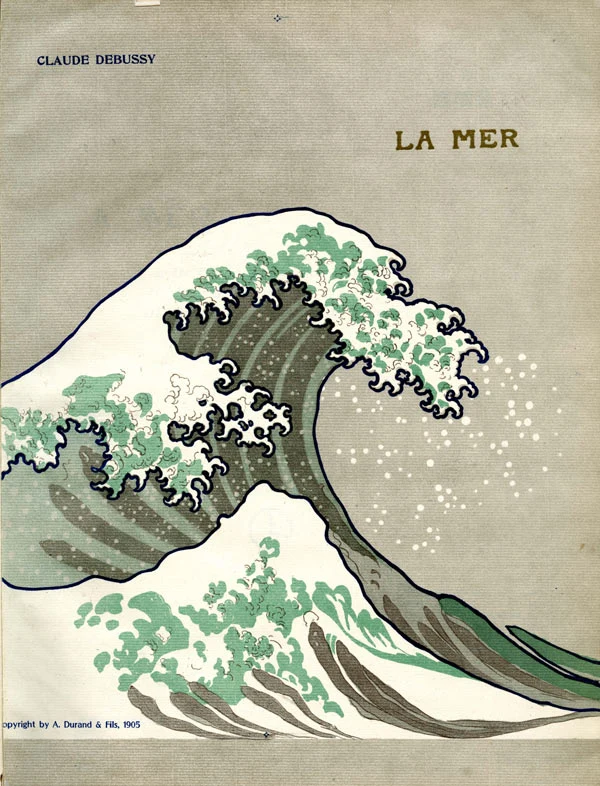
Across Paris and Normandy, Edo print spatial grammar reverberated well beyond oil painting. Claude Monet amassed more than two hundred Japanese prints inside his house at Giverny, adapting off-center composition, cropped framing, and elevated horizon-free intimacy into garden motifs such as Bridge over a Pond of Water Lilies (1899). Meanwhile, composer Claude Debussy kept a reproduction of The Great Wave pinned on the wall of his Paris study while composing his three-movement orchestral triptych La Mer; upon publication of the first full score by A. Durand & Fils in 1905, Debussy himself approved a cropped green-and-ivory adaptation of Hokusai’s curling wave for the cover, binding nineteenth-century Edo craft permanently to twentieth-century European modernity.
Carry the Painting & Its Curated Description
Every keepsake below features Katsushika Hokusai’s The Great Wave off Kanagawa on the front and its curated description on the reverse, with free US shipping.
 $35
Canvas Tote Bag
15" × 16" Natural Canvas
 $22
Ceramic Mug
11oz White Glazed Ceramic
 $38
Throw Pillow
16" × 16" Woven Canvas w/ Insert
 $28
Hardcover Journal
5.75" × 8" Ruled Pages (150pp)
 $18
Ceramic Ornament
3" Round Porcelain w/ Gold Cord
Frequently Asked Questions About The Great Wave off Kanagawa
Is The Great Wave off Kanagawa a painting, and how many originals exist?
No. The Great Wave off Kanagawa is not a one-of-a-kind brush painting on silk or canvas, but a polychrome woodblock print (nishiki-e) carved onto wooden printing matrices around 1830–1832. Historians estimate Eijudō pulled as many as 8,000 impressions until the cherrywood blocks wore down; roughly 110+ original Edo-period impressions survive today in major museums including The Metropolitan Museum of Art, the British Museum, and The Art Institute of Chicago.
Is the wave in Hokusai’s print actually a tsunami?
Oceanographers and Edo maritime historians generally classify it not as a seismic tsunami, which travels as a broad low-profile surge in deep water, but as a towering plunging wind wave or freak rogue swell generated out in Sagami Bay off Kanagawa (modern Yokohama). Either way, the three fishermen crouch smoothly inside long slender oshiokuri-bune delivery craft built to cut swiftly into heavy swells.
Why did Prussian blue make Hokusai’s print revolutionary in 1831?
Traditional blue plant dyes in Japan, such as dayflower petal extract (tsuyukusa) and lighter indigo mixes, tended to fade quickly under indoor light or yield soft, hazy tones. Imported from Europe via Nagasaki as bero-ai ("Berlin blue"), synthetic Prussian blue delivered deep saturation, wide tonal grading from faint sky mist to midnight shadow, and strong resistance to light fading, igniting an immediate print craze across Edo.
Who was riding inside the three wooden boats?
All thirty figures are commercial crews aboard oshiokuri-bune ("push-through boats"), fast oar-driven transport barges used in the Edo period to rush live fish caught off coastal peninsulas to Tokyo markets. Each hull typically carried eight rowers and two relief crewmen braced along the planks while steering through choppy coastal water toward Edo.