Why Sandro Botticelli Painted The Birth of Venus on Woven Linen Instead of Wood
Technical notes on tempera magra, Medici orange groves, Praxiteles’ marble geometry, and the 1987 Opificio delle Pietre Dure restoration in Florence.
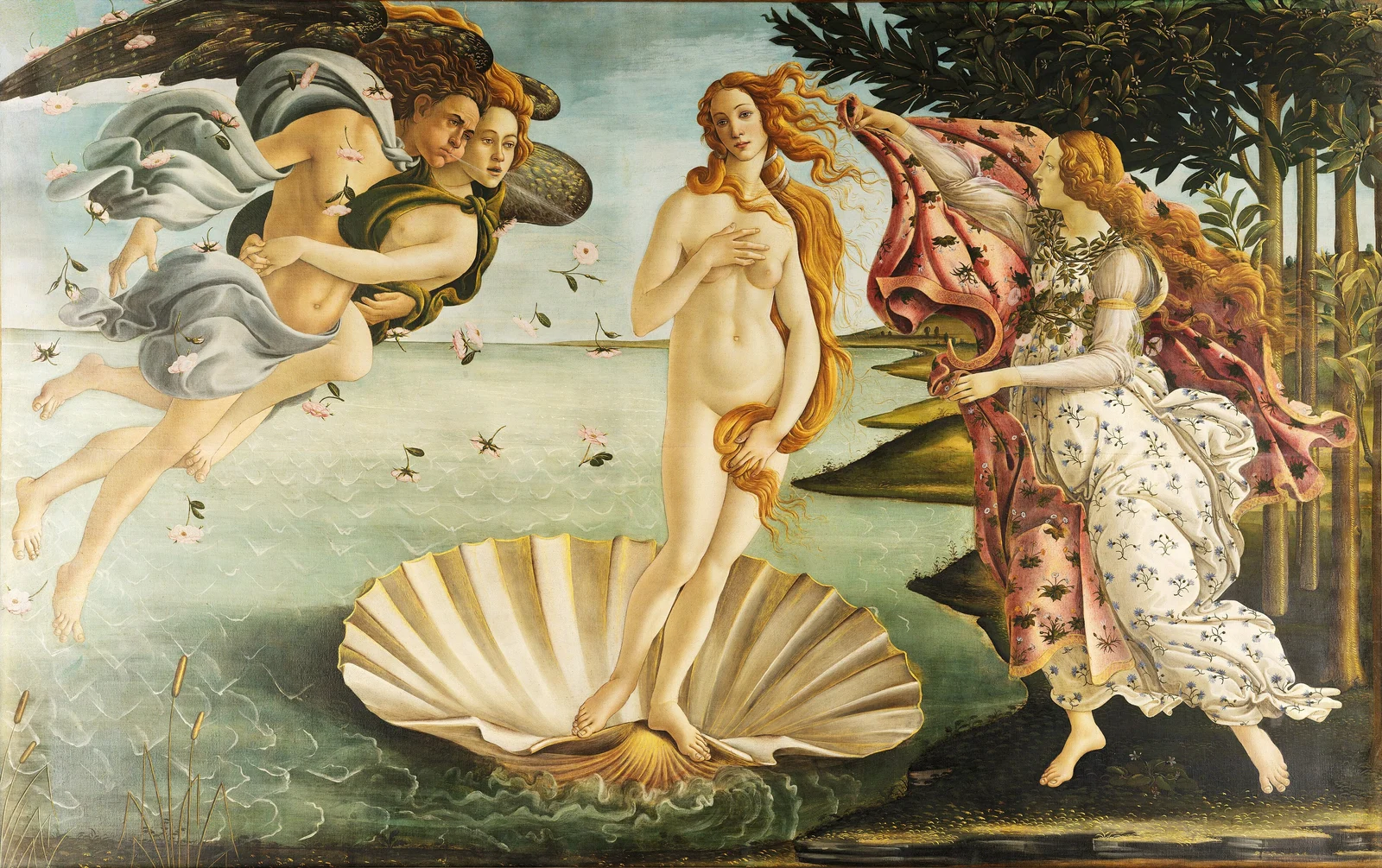
- Original Title
- La Nascita di Venere
- Artist
- Sandro Botticelli (Alessandro di Mariano di Vanni Filipepi, 1445–1510)
- Date
- c. 1484–1486
- Medium & Support
- Tempera magra (animal-glue and egg-yolk binder) with powdered shell gold on two stitched strips of woven linen canvas
- Dimensions
- 172.5 × 278.5 cm (67.9 × 109.6 in)
- Repository
- Gallerie degli Uffizi, Florence (Sala 10–14, Inv. 1890 no. 878)
- Provenance
- Recorded in 1550 by Giorgio Vasari at the Villa di Castello (estate of Lorenzo di Pierfrancesco de’ Medici); transferred to the Uffizi in 1815
- Diagnostic Conservation
- 1986–1987 restoration directed by Alfio Del Serra at the Opificio delle Pietre Dure, Florence
An enduring pinnacle of the Italian Renaissance, this landmark allegory revived classical antiquity and Neoplatonic philosophy, equating earthly beauty with divine spiritual grace. Rejecting heavy anatomical weight, the composition favors lyrical, flowing linearity and graceful contours inspired by ancient Greco-Roman sculpture. Pioneering for its era, the work was painted in tempera on woven linen canvas rather than traditional wood panel, and illuminated with delicate shell-gold highlights that catch the light across the surface.
Material & Compositional Details
Enlarged regions from the open-access Uffizi photograph highlighting Botticelli’s linen preparation, sculptural adaptation, and mineral pigments.
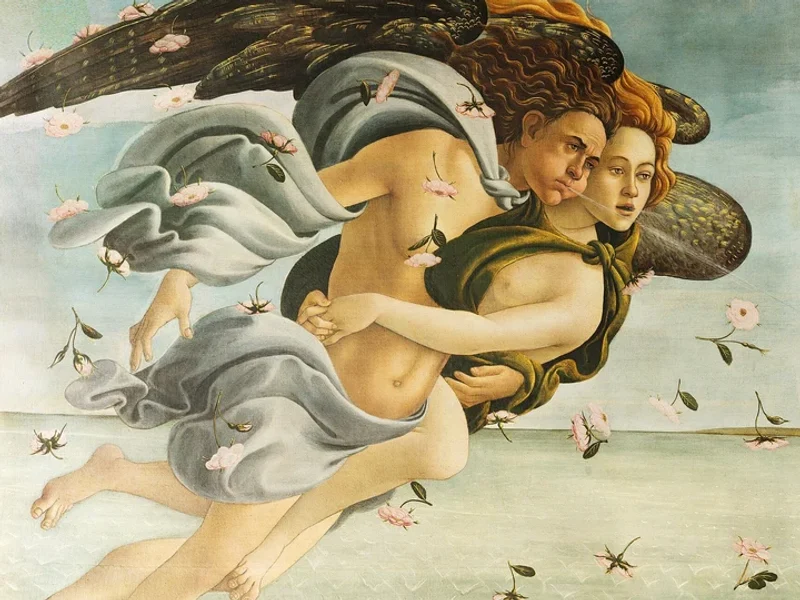
Zephyr, Aura, and the Blue-Tinted Gypsum Ground
Instead of heavy oil glazes, Botticelli primed the linen with crystalline gypsum tinted faintly blue. The pale blue-gray sky and V-shaped sea ripples sit thinly over that reflective ground, framing Zephyr and Aura as they blow pink damask roses toward Cyprus.
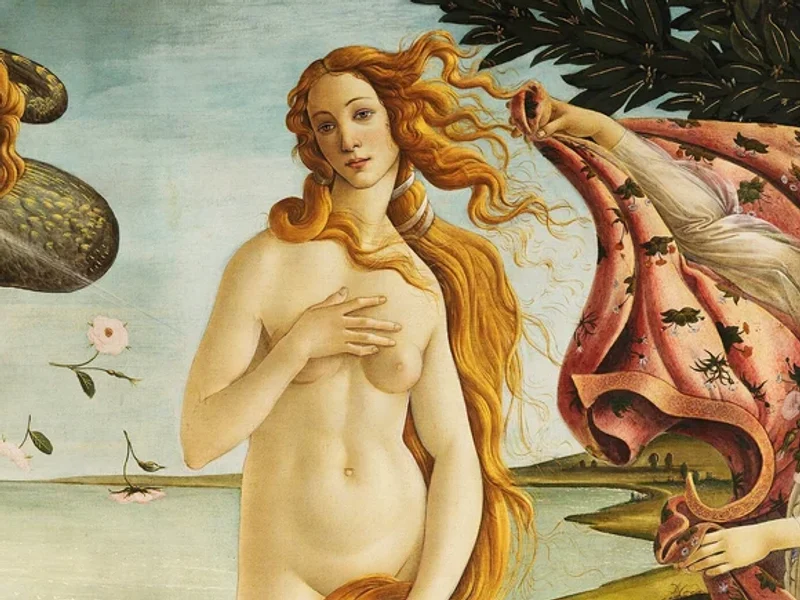
The Venus Pudica Silhouette Without Gravity
Botticelli borrowed the modest gesture of ancient Greco-Roman Venus Pudica marble statues derived from Praxiteles’ Aphrodite of Knidos, then loosened anatomy for rhythmic outline: lengthening her neck, dropping her left shoulder steeply downward, and poised weightlessly on her right toes.
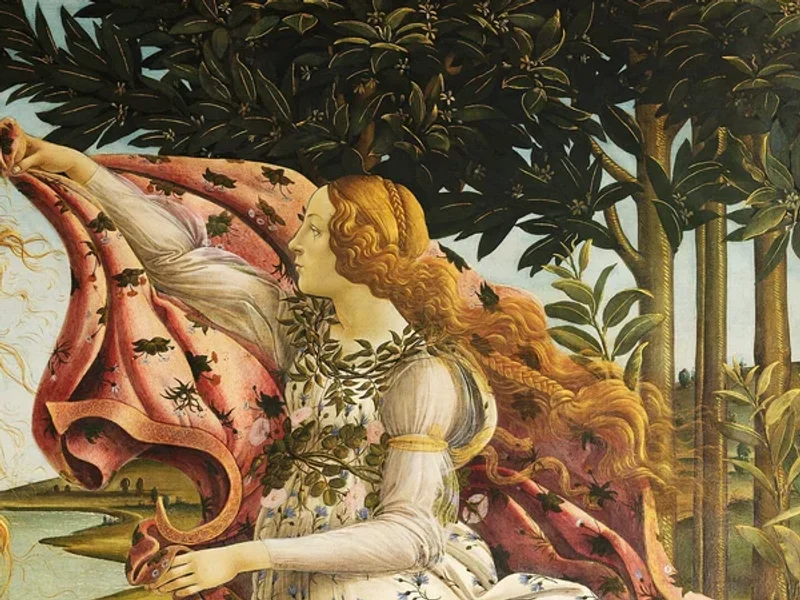
Medici Bitter Oranges (Mala Medica) & Shell Gold
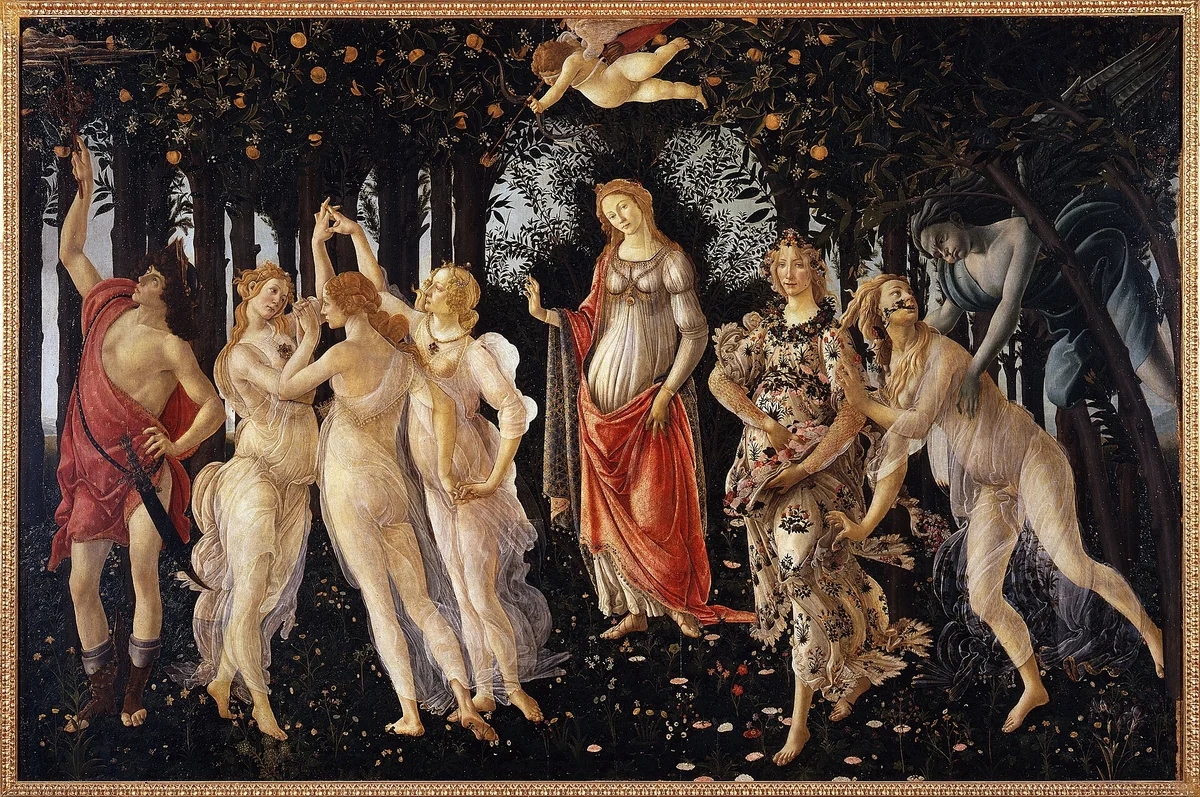
Behind the Hora of Spring stands a grove of flowering and fruiting orange trees (mala medica in Latin), a botanical play on the Medici family name. Botticelli brushed genuine powdered gold mixed with gum (shell gold) over the leaves, petals, hair locks, and cloak seams.
Walk past Sandro Botticelli’s Primavera in Room 10–14 of the Uffizi Gallery and turn toward The Birth of Venus, and the first difference is physical before it is poetic. Primavera gleams on eight thick poplar planks sealed in dark, resinous oil-tempera glazes. Its companion across the floor looks almost like a detached wall fresco: pale, matte, chalk-bright, and stitched across a coarse linen weave nearly nine feet wide.
Why Botticelli Chose Woven Linen Over Poplar Wood
In 1480s Florence, almost every major religious altarpiece or palace narrative was built on seasoned poplar panels braced from behind with wooden battens. Panel paintings stood up well in dry stone chapels, yet large composite panels could measure hundreds of pounds and split along join lines inside damp suburban villas. Canvas was known in Tuscan workshops primarily for processional banners, festival hangings, and decorative wall cloths (panni dipinti), not permanent mythological monuments at 172.5 × 278.5 cm.
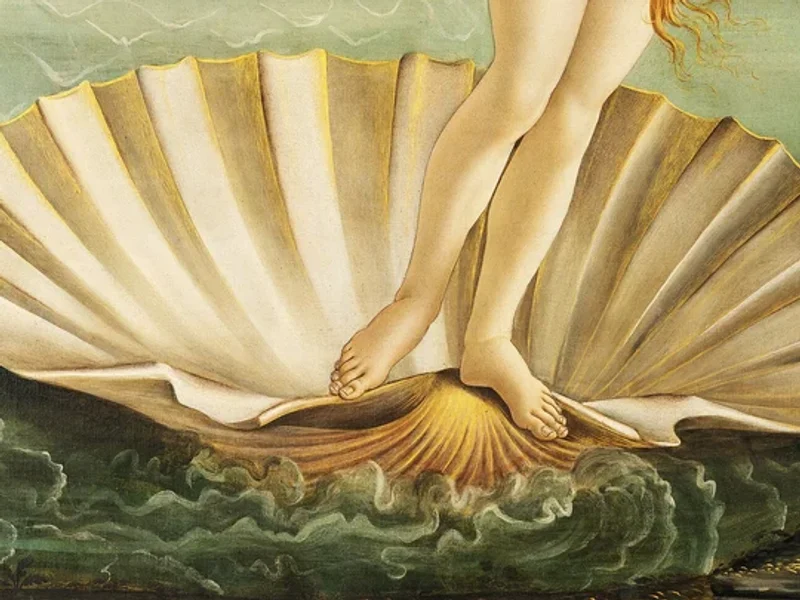
Botticelli stitched together two lengths of fine linen cloth along a central vertical seam and primed the surface with a refined, alabaster-like gypsum ground mixed with a minimal animal-glue binder and a trace of blue pigment. Scientific cross-sections analyzed during the Uffizi conservation campaign show he worked quickly in tempera magra, using sparse animal-glue and egg-based media without thick oil varnishes. Because linen fabric absorbed little oil and the white-and-blue gypsum reflected daylight right back through the thin pigment layers, the finished scene carried the airy, matte clarity of an antique fresco while remaining light enough to hang and transport between rooms.
The Villa di Castello and Poliziano’s Unfinished Jousting Poem
No surviving fifteenth-century contract names the original patron of The Birth of Venus. Our earliest eyewitness account comes from the Florentine painter and biographer Giorgio Vasari, who wrote in the 1550 edition of Le Vite that he saw both Primavera and Venus emerging from the sea hanging together at the Villa di Castello, the country residence a few miles northwest of Florence owned by Lorenzo di Pierfrancesco de’ Medici and his brother Giovanni.
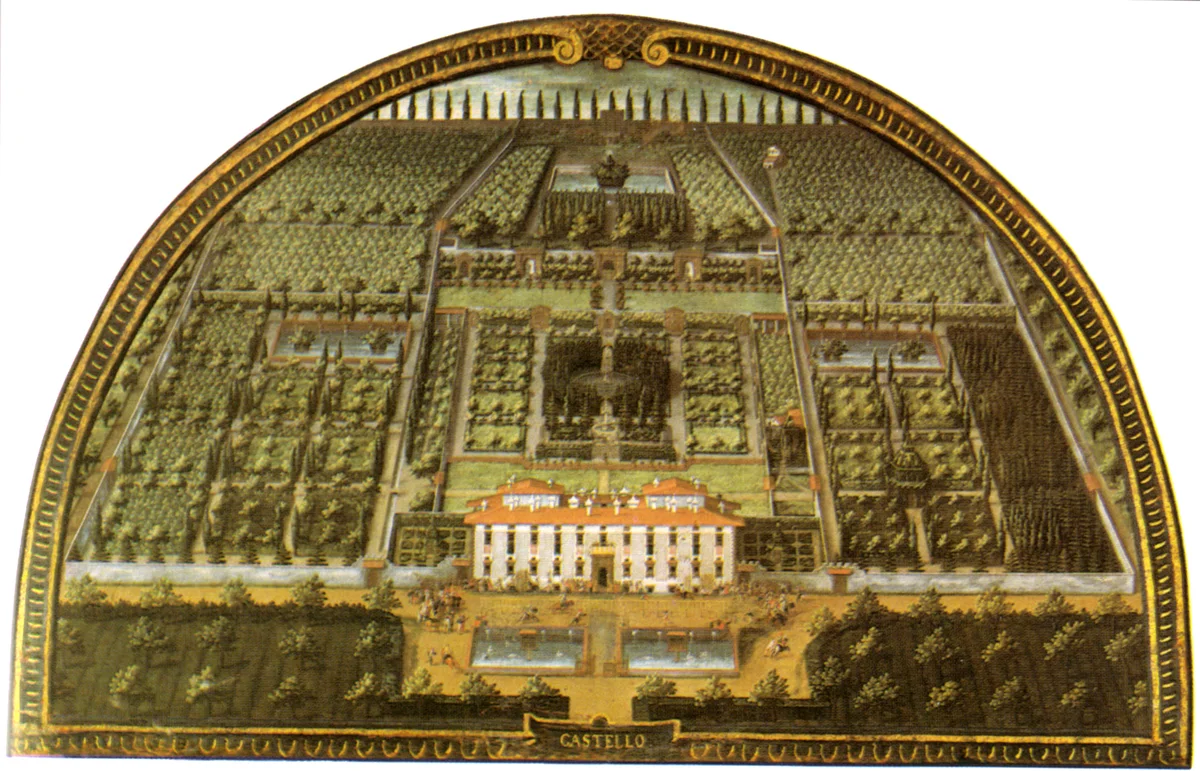
Rather than illustrating the terrifying origins in Hesiod’s Theogony, Botticelli followed the vernacular verse of Angelo Poliziano, tutor and court poet in the Medici household. In Stanzas 99 to 101 of Poliziano’s Stanze cominciate per la giostra (1475–1478), the poet imagines an ancient relief carving on the doors of Venus’s palace in Cyprus: the sea-born goddess floating shoreward on a shell, pushed by amorous winds wearing misty wings, as the Hora on the bank waits to wrap her in a starry robe. To Neoplatonic scholars in Florence such as Marsilio Ficino, that arrival carried a spiritual lesson as well as a classical story, linking the contemplation of earthly harmony to higher divine truth.
Classical Sculpture Rebuilt Without Anatomical Weight
By the 1480s, leading Florentine masters prized anatomical volume, cast shadows, and strict single-point linear perspective. In The Birth of Venus, Botticelli deliberately sets aside all three. The horizon line behind the figure runs flat and high, the waves shrink into stylized golden V-strokes borrowed from manuscript illumination, and no figure casts a heavy shadow across the green shore.
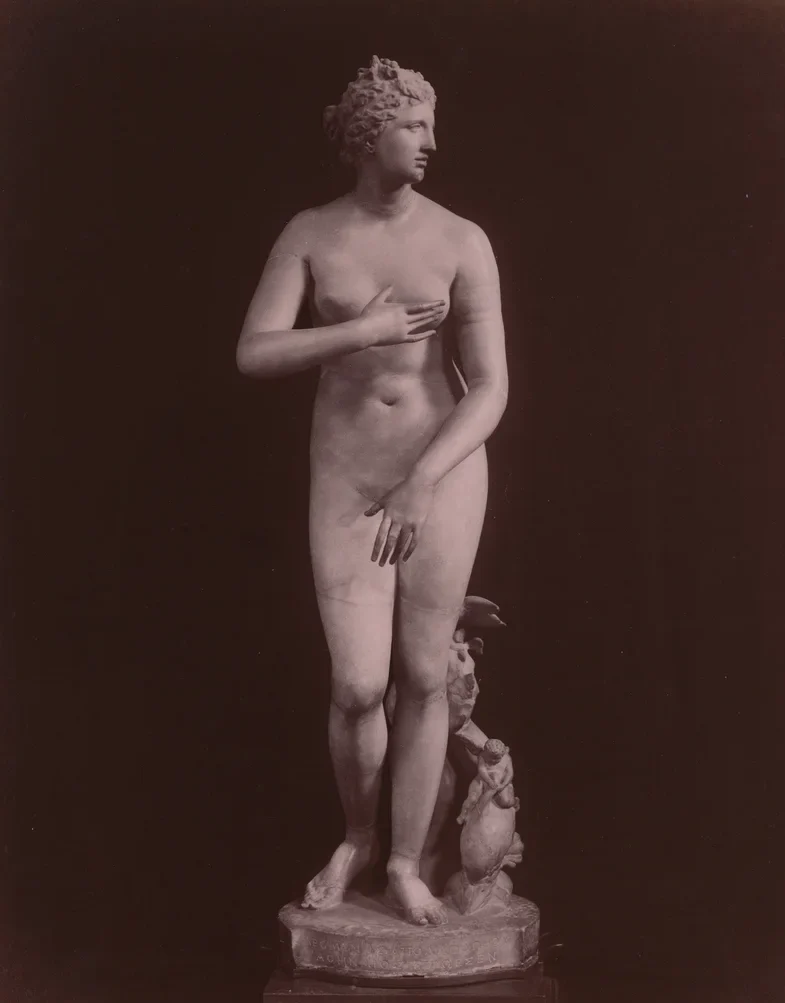
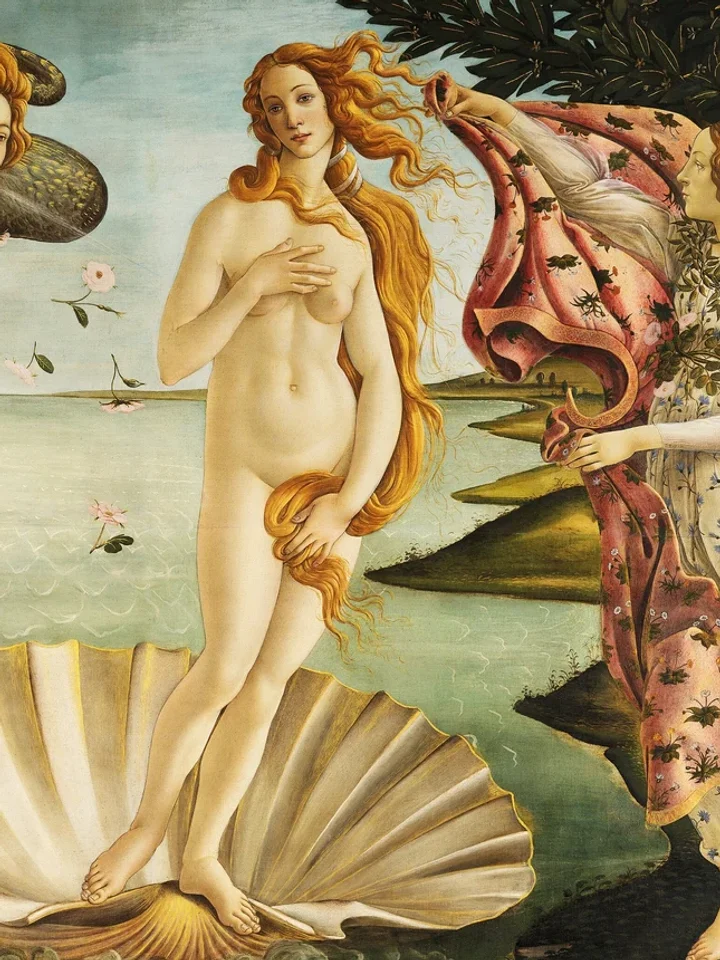
For Venus herself, Botticelli drew directly on an ancient Greco-Roman sculptural type known as Venus Pudica (the modest Venus, descended from Praxiteles’ fourth-century BCE Aphrodite of Knidos and known in Florence through Roman marble copies). Yet where carved marble obeys gravity over a bent contrapposto leg, Botticelli elongates Venus’s neck, curves her spine into a smooth S-line, and drops her left shoulder steeply so her torso reads like a lyrical calligraphic contour. She stands on the lip of the scallop shell with almost no downward pressure, suspended at the very instant before the Hora drapes the daisy-embroidered pink mantle over her.
Inside the 1987 Opificio delle Pietre Dure Restoration
Over five centuries after leaving Botticelli’s workshop, centuries of yellowed oil varnishes, darkened candle grime, and older nineteenth-century overpaint had veiled the cool greens of the Adriatic-inspired sea and turned the blue-tinted gypsum ground a muddy ochre. Between 1986 and 1987, restorer Alfio Del Serra directed a landmark conservation and diagnostic project under Florence’s Opificio delle Pietre Dure alongside researchers Mauro Matteini and Arcangelo Moles.
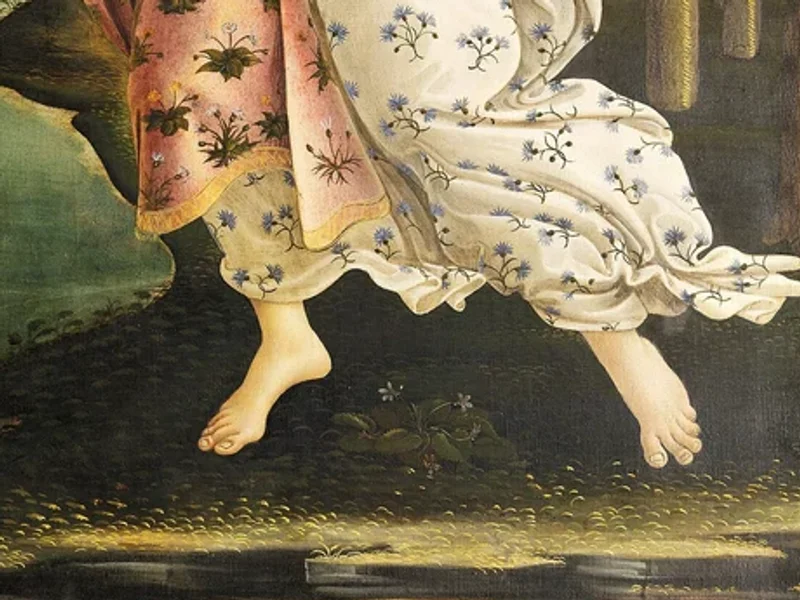
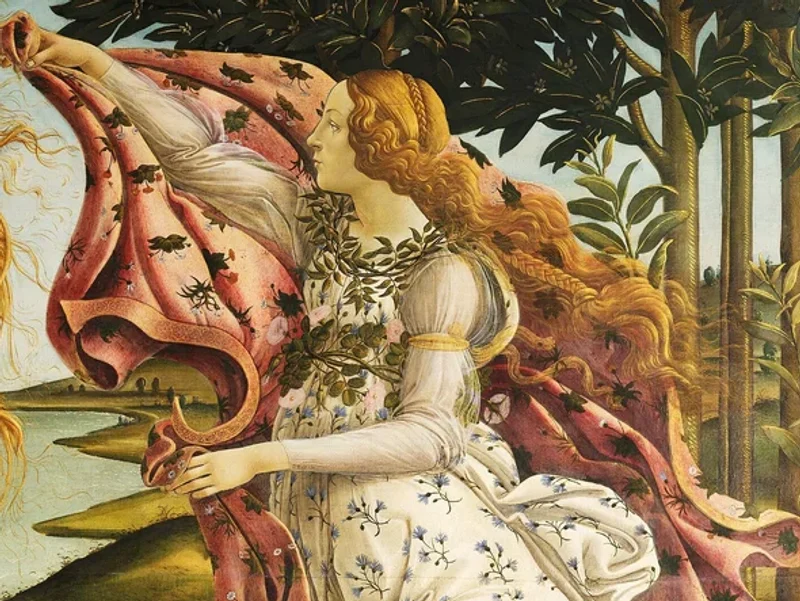
Removing the degraded surface varnish revealed the luminous transparency of the original tempera and copper-based verdigris glazes on the orange trees. Infrared reflectography conducted during the study also let curators peer underneath the paint film to see Botticelli’s carbon underdrawing and mid-process changes (pentimenti). On the right bank, scans revealed that the artist had originally drawn low classical sandals onto the bare feet of the Hora of Spring before deciding to leave her barefoot in the grass, along with subtle revisions to the collar of the floral cloak, the tilt of Venus’s eyes, and drifting strands of hair.
Precedents & Influences Behind the Painting
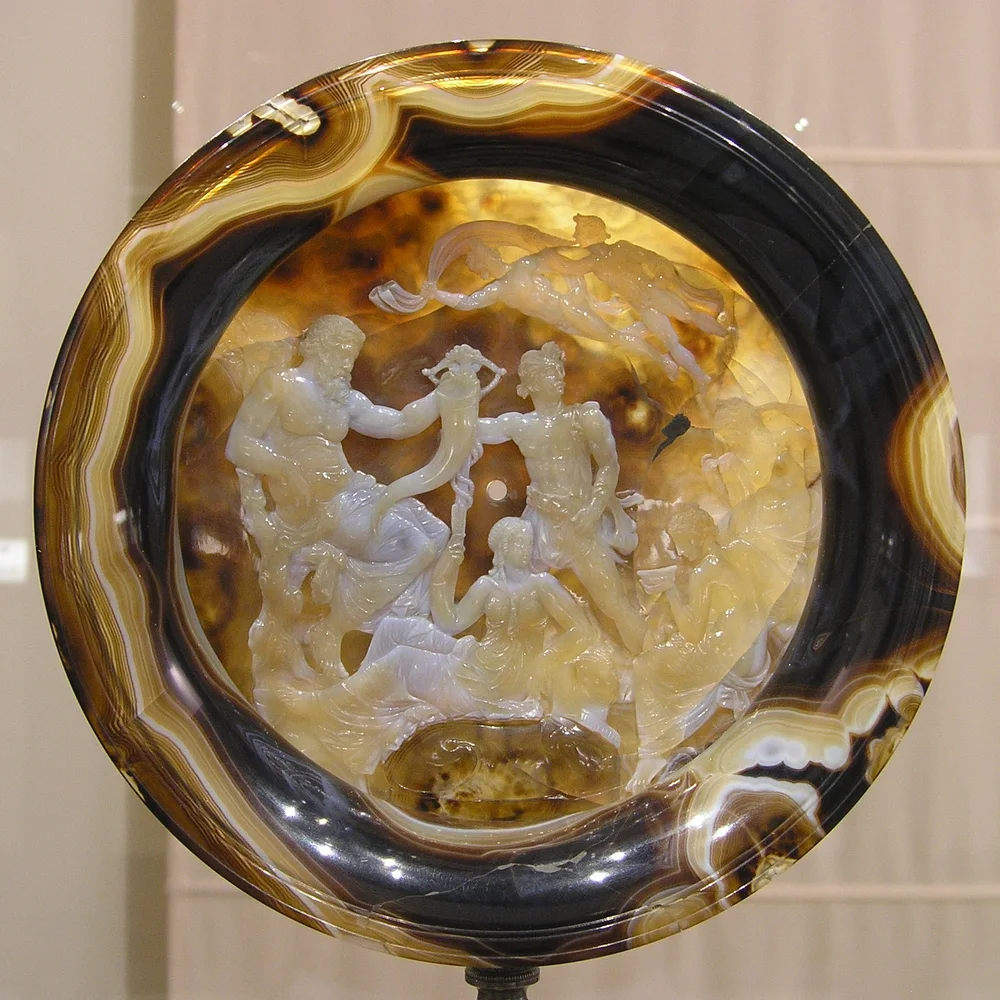
The Birth of Venus emerged directly out of fifteenth-century Florence’s hunger to rival classical antiquity from scattered literary descriptions and treasured antiquities. In De pictura (1435), humanist Leon Battista Alberti urged painters to reconstruct renowned lost masterpieces described by ancient writers, among them Apelles’ fifth-century BCE Venus Anadyomene (Venus Rising from the Sea), celebrated by Pliny the Elder in his Naturalis Historia. Because no Greek or Roman wall paintings of the subject were known in 1480s Tuscany, Botticelli looked instead to three-dimensional carvings in Florentine collections, most notably Lorenzo de’ Medici’s prized Hellenistic sardonyx cameo cup, the Tazza Farnese, whose airborne pair of wind deities gliding across the upper rim provided an unmistakable antique model for Zephyr and Aura.
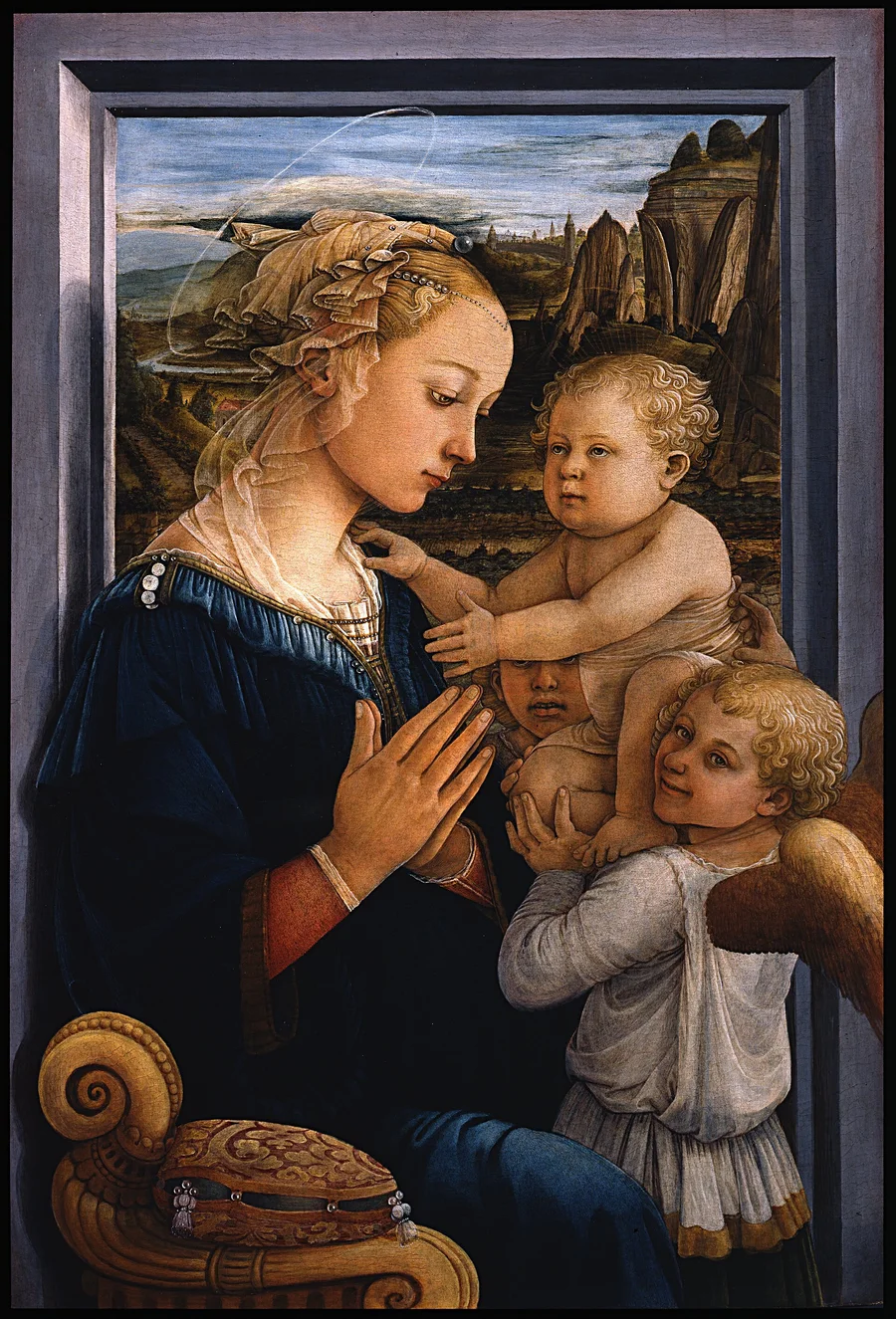
Just as decisive were Botticelli’s own Florentine workshop roots. Trained in the studio of Carmelite friar Fra Filippo Lippi during the 1460s, Botticelli absorbed Lippi’s gift for translucent veils, coiling blond hair, and tender linear modeling, then sharpened those lyrical contours against the taut, muscular disegno of contemporaries Antonio and Piero del Pollaiuolo. Even the tripartite staging of the canvas transposed a Christian iconography every Florentine churchgoer knew by heart: placing a serene central figure standing in shallow water while an attendant leans forward from the right shore bearing drapery reimagines traditional Tuscan Baptism of Christ compositions as a pagan rebirth.
Onward Influence
For more than three centuries, The Birth of Venus remained largely out of public view in the Medici villa at Castello before entering the Uffizi Gallery in 1815, and Botticelli himself was eclipsed by the High Renaissance masters who followed him. When the canvas finally gained an audience during the mid-nineteenth century, its lyrical outline and flattened pictorial space struck young painters looking beyond strict academic modeling. During his formative 1858 to 1859 stay in Florence with his Bellelli relatives, a twenty-four-year-old Edgar Degas sketched and painted a direct study after Botticelli’s central figure in the Uffizi, internalizing the Renaissance painter’s crisp contour line and asymmetrical spatial balance that later resurfaced in Parisian rehearsal scenes such as The Dance Class (1874).
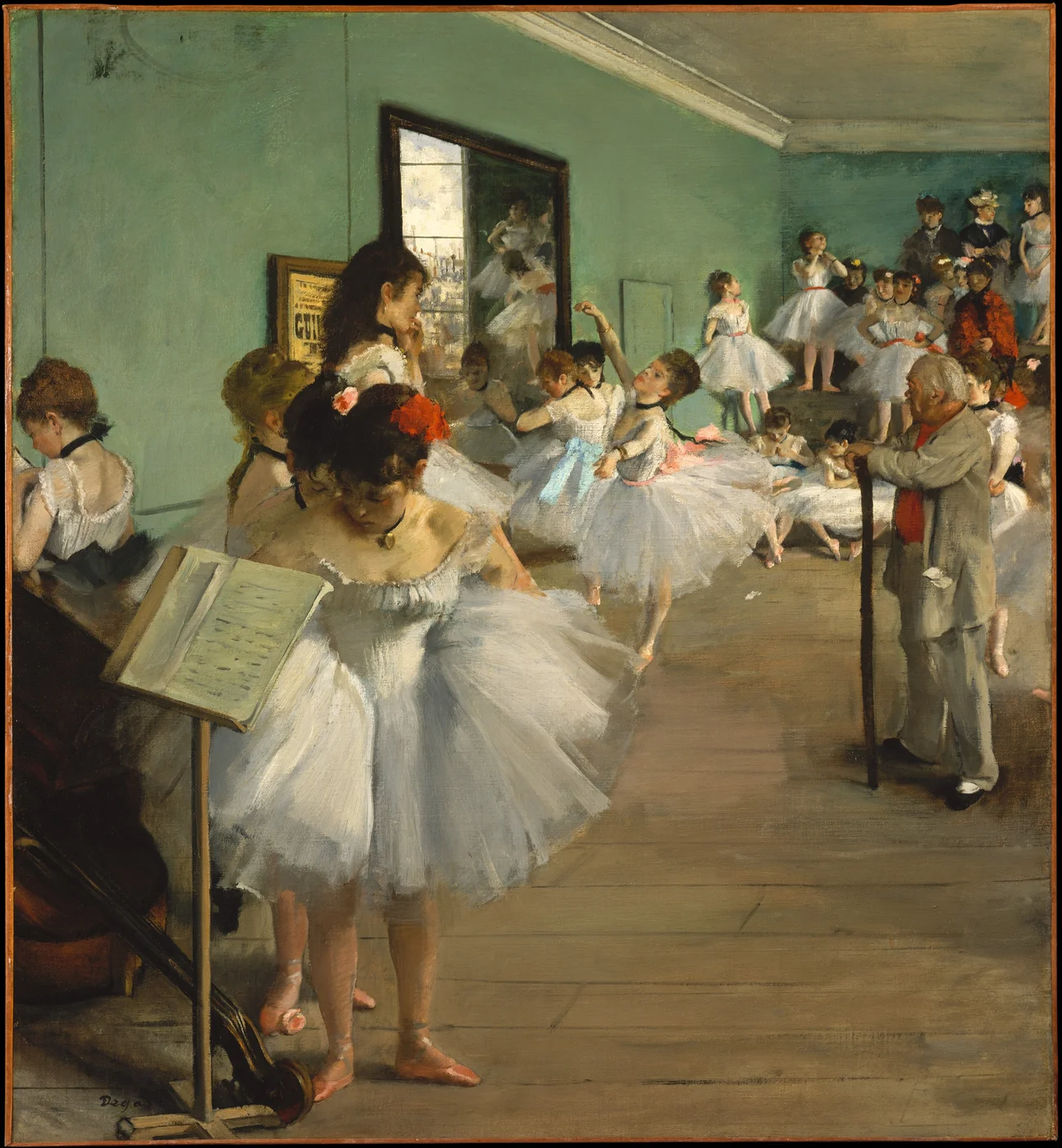
Edgar Degas, The Dance Class, 1874 (The Met). Degas studied and copied Botticelli’s Venus in the Uffizi during his 1858–1859 Florentine sojourn. Explore this work in our collection →
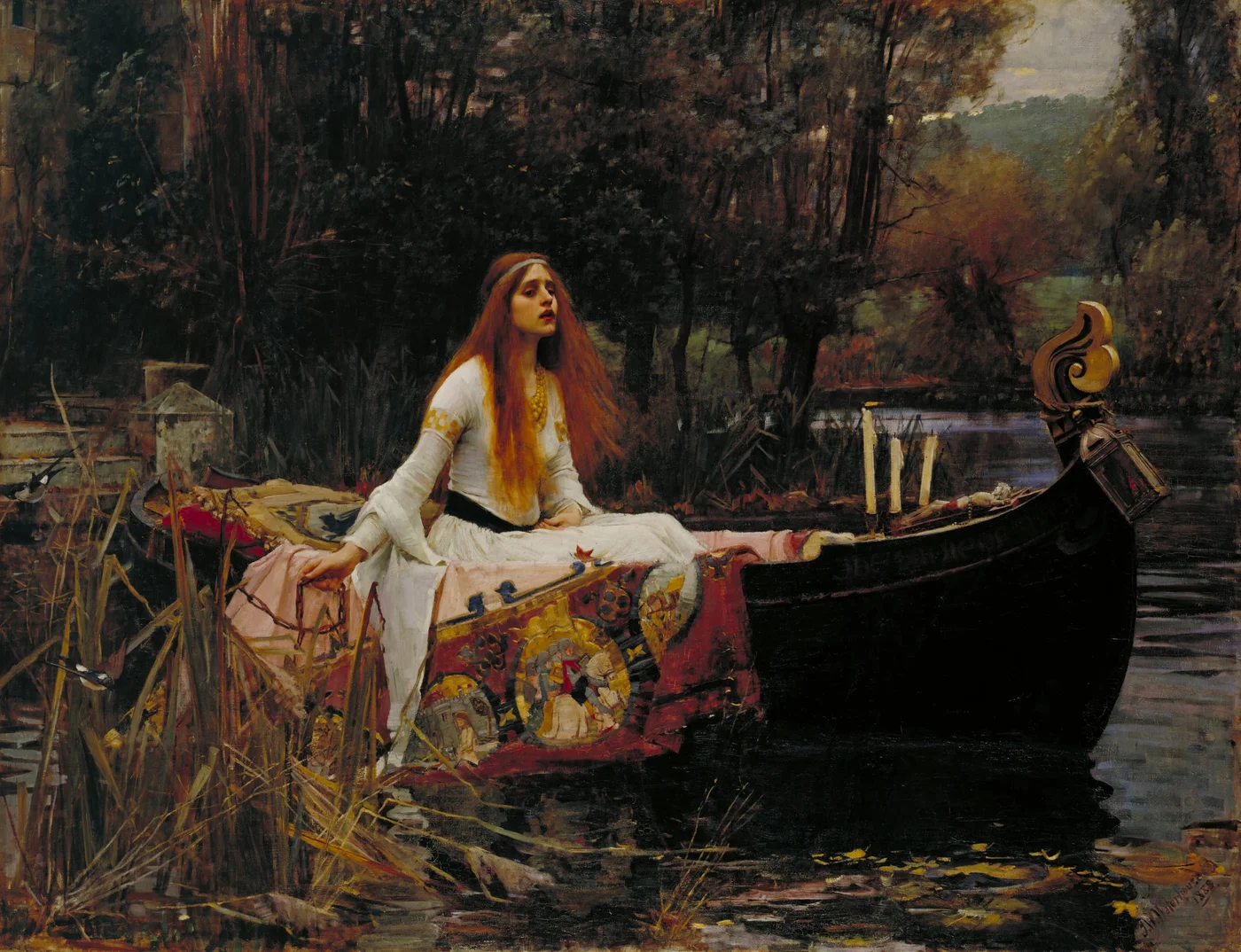
John William Waterhouse, The Lady of Shalott, 1888 (Tate). Late Pre-Raphaelite painters drew directly on Botticelli’s drifting hair and elegiac allegory. Explore this work in our collection →
At the same moment in Britain, poets and critics including Dante Gabriel Rossetti, Algernon Charles Swinburne, and Walter Pater (whose influential 1870 essay on Botticelli placed the artist at the heart of Renaissance aestheticism) sparked an international revival. That enthusiasm reshaped late Pre-Raphaelite painting, reverberating in the wind-blown copper hair, flowing drapery, and suspended narrative mood of John William Waterhouse’s The Lady of Shalott (1888) as well as early twentieth-century Art Nouveau linework.
Carry the Painting & Its Curated Description
Every keepsake below features Sandro Botticelli’s The Birth of Venus on the front and its curated description on the reverse, with free US shipping.
 $35
Canvas Tote Bag
15" × 16" Natural Canvas
 $22
Ceramic Mug
11oz White Glazed Ceramic
 $38
Throw Pillow
16" × 16" Woven Canvas w/ Insert
 $28
Hardcover Journal
5.75" × 8" Ruled Pages (150pp)
 $18
Ceramic Ornament
3" Round Porcelain w/ Gold Cord
Frequently Asked Questions About The Birth of Venus
Why did Sandro Botticelli paint The Birth of Venus on linen canvas instead of wood panel?
In fifteenth-century Florence, large panel paintings were built on heavy poplar planks prone to warping in damp country villas. Botticelli chose two stitched pieces of woven linen primed with a luminous, blue-tinted gypsum ground and painted in lean tempera (tempera magra), giving a massive nine-foot work the matte glow of a wall fresco while remaining light enough to hang and move.
Who commissioned The Birth of Venus, and where did it originally hang?
While the original payment contract has not survived, Giorgio Vasari recorded seeing the painting in 1550 alongside Primavera at the Villa di Castello near Florence, the estate of Lorenzo di Pierfrancesco de’ Medici (second cousin of Lorenzo the Magnificent). The painting stayed at Castello until 1815, when it entered the Uffizi Gallery.
Who are the four figures in Botticelli’s The Birth of Venus?
In the center stands Venus (goddess of love and beauty) arriving on a scallop shell blown toward the shore of Cyprus. On the left, the winged western wind Zephyr embraces a gentle breeze figure (identified either as Aura, breeze, or Chloris). On the right shore stands one of the Horae (goddesses of the seasons, representing Spring) holding out a flower-embroidered mantle.
What did the 1987 Uffizi restoration reveal about The Birth of Venus?
The 1986 to 1987 conservation project directed by Alfio Del Serra and the Opificio delle Pietre Dure stripped away centuries of yellowed varnishes to recover the matte tempera luminosity and shell-gold highlights. Infrared reflectography also uncovered several pentimenti (painterly revisions), including classical sandals originally drawn on the Hora’s feet and adjustments to Venus’s eyes, hair, and cloak.